Diamond grinding vs acid etching: how a garage floor should be prepped
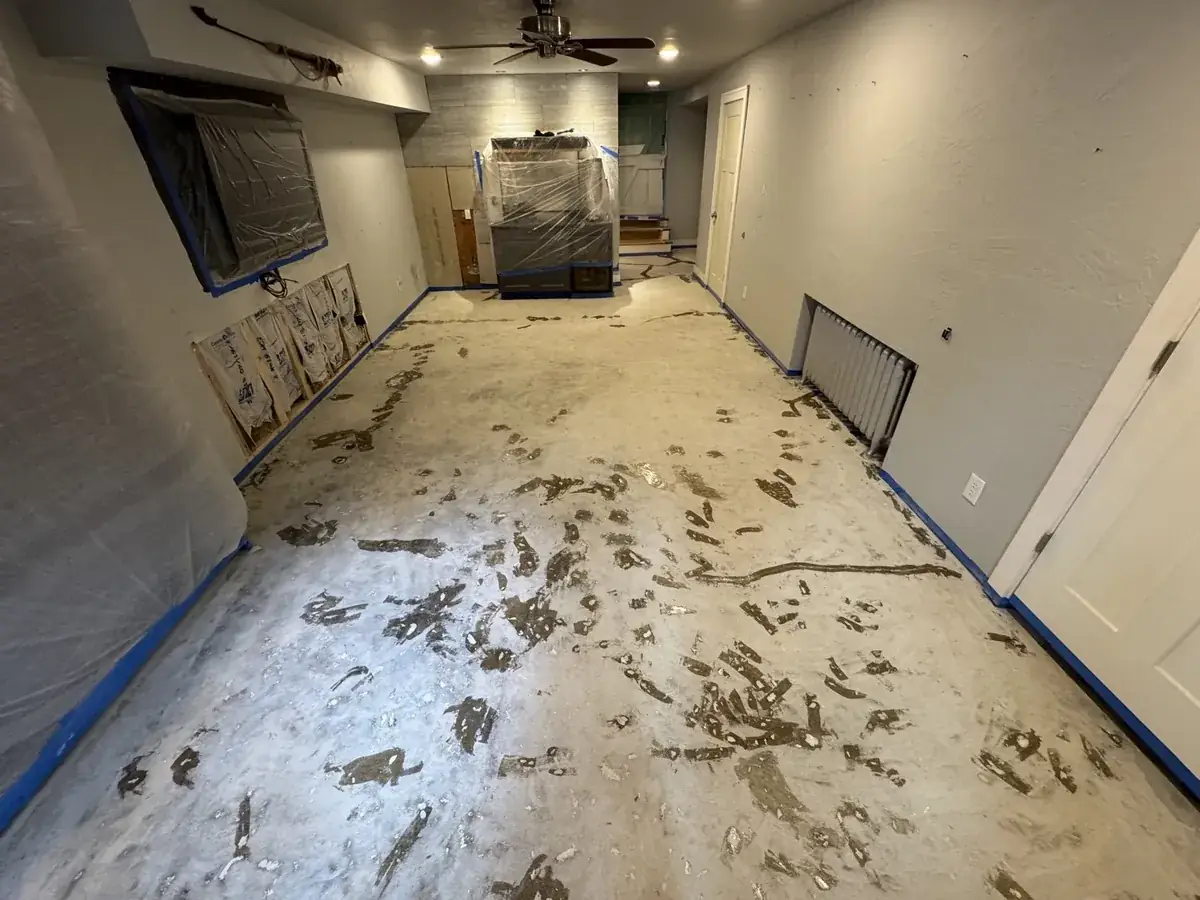
Ask three companies how they prepare a garage floor and you may hear three answers: an acid wash, a diamond grinder or a shot blaster. That answer says more about whether a floor stays bonded than the name on the coating, because a coating can only hold onto the surface it is given.
Rhino Coatings installs a polyurea base coat with a polyaspartic top coat over diamond-ground concrete. We do not install epoxy, and we do not acid-etch. This guide covers what each prep method does to a slab, what the standards and the coating makers' data sheets ask for, and how to tell whether a floor was prepped well, whoever does the work.
What is the best way to prep a garage floor for a coating?
Mechanical prep. A diamond grinder or a shot blaster cuts the top of the slab down to clean, sound concrete, the damage is repaired, and the floor is left clean and dry for the base coat.
The International Concrete Repair Institute (ICRI) lists what prep has to do before a coating: remove laitance, oil, films and old coatings, remove weak or contaminated concrete, open the pores and create a surface profile (ICRI's summary of its surface preparation guideline). Acid etching manages part of that list on a bare, clean slab. Grinding and shot blasting go further, because they cut away the surface itself along with whatever is on it. One resin flooring manufacturer's technical article says most coating manufacturers no longer recommend acid etching.
Why does prep decide whether a coating stays bonded?
A coating grips only the thin top layer of concrete it touches. If that layer is weak, oily or sealed, the coating is bonded to the wrong thing, and when that layer lets go, the coating goes with it.
- Laitance. A weak, milky layer of cement dust, lime and fine sand that excess water leaves on the surface of fresh concrete, as the same manufacturer's article defines it.
- Curing compounds and topical sealers. Both leave a film on the concrete, a curing compound to slow water loss while the slab cures and a sealer to keep liquids out, when a base coat needs open concrete to bond into. One flooring maker's technical bulletin calls for both to be removed by mechanical abrasion.
- Oil. Years of drips soak into bare concrete, and coating data sheets ask for a surface free of grease and oil.
- Old coatings. Paint, epoxy and sealer have their own bond to the concrete, and a new coating laid over them can hold no better than that bond.
- Damage. Cracks, spalls and pitting are repaired as part of prep, as our concrete repair page explains.
When we are called out to a floor that is peeling or bubbling, the problem almost always traces back to prep that was not done with diamond grinders.
What is acid etching, and what does it leave behind?
Acid etching is a wet chemical prep that dampens the slab, scrubs an acid solution into it and rinses it off with plenty of water. It removes laitance and lightly roughens a clean, bare slab, but it leaves water and possible residue in the concrete, and it cannot take off curing compounds or oily deposits.
The acid is usually hydrochloric acid, sold as muriatic acid, or a buffered phosphoric acid, as the resin flooring article explains. It dissolves cement at the surface and leaves a finish like sandpaper, according to one coating equipment maker's guide to surface prep. The standard practice for it is ASTM D4260, which describes it as a way to alter the surface profile and remove laitance and foreign material before a coating goes on.
The profile it leaves
Surface texture is graded against ICRI Technical Guideline 310.2R, which defines ten concrete surface profiles, from CSP 1, minimal roughness, to CSP 10, very rough, with more than a quarter inch of relief. On its comparison chart, acid etching produces CSP 1 to 3, the smooth end of the scale. The resin flooring article notes that an etched surface can end up uneven, over-etched or under-etched.
What acid cannot remove
The resin flooring article says etching cannot remove curing compounds, oily deposits or other material that water does not dissolve, any of which can interfere with a coating's bond. Topical sealers need mechanical removal, as the flooring maker's bulletin says, and one polyurea floor system's installation guide calls for previous coatings and sealers to be removed completely, with the slab diamond-ground or shot-blasted to CSP 3 or greater.
The water and the residue
Etching soaks the slab right before it is supposed to be coated. The contractor then has to wait for it to dry completely, which can take days, or switch to a moisture-tolerant primer, the resin flooring article notes. Our guide to moisture in concrete explains why that matters.
ASTM keeps a separate test method, ASTM D4262, for checking the pH of an etched surface after the final rinse, because residual chemicals that rinsing misses may hurt a coating's adhesion. The resin flooring article adds that many agencies restrict washing the solution down a drain, neutralized or not.
Handling the acid
NIOSH lists eye and skin burns from hydrochloric acid solutions, and nose and throat irritation, coughing and choking from breathing hydrogen chloride (NIOSH Pocket Guide to Chemical Hazards). The safety data sheet for one muriatic acid carries the signal word Danger, warns of severe skin burns, eye damage and respiratory irritation, and says to use it only outdoors or in a well-ventilated area.
Many DIY kits rely on an etch, and our guide to what DIY epoxy kits actually last covers how that plays out. We do not acid-etch any floor we coat.
What is diamond grinding, and what profile does it leave?
Diamond grinding cuts the surface of the slab away with diamond tooling, taking laitance, sealers, curing compounds, old coatings and contamination with it and leaving open, sound concrete. ICRI's chart puts its profile at CSP 1 to 2, and coating makers name it as a way to reach the CSP 2 or 3 their products ask for.
So grinding and etching overlap on roughness, and ASTM's practice for preparing concrete by abrasion, ASTM D4259, states nearly the same aims as the etching practice. The difference is what each one removes and what it leaves behind. A grinder takes the surface off physically, so whatever was on it comes off too, and a slab ground dry with the dust collected takes on no water. Some floors are ground wet, and one polyaspartic coating's data sheet says those have to dry fully before coating.
The finish a grinder leaves, from smooth to polished, depends on the roughness of its abrading discs, the equipment maker's guide notes, and one polyaspartic top coat's data sheet names diamond grinding to an 80 to 120 grit finish, for a CSP 2, as its preferred prep. ICRI's own summary points specifiers to the coating maker's recommendations.
We diamond-grind every slab we coat. The grind removes the laitance, opens the pores and leaves the surface profile our coating system calls for. We do not coat over an old coating.
What about shot blasting?
Shot blasting is another mechanical method, and it can cut a much rougher profile than grinding. A wheel throws steel shot at the slab, the impacts break up the surface and the contaminants on it, and the spent shot is separated out and reused, the equipment maker's guide explains. ICRI calls it a contained, dust-free system with a range of CSP 2 to 9.
That range matters most for thick resin floors, epoxy included, and the resin flooring article names shot blasting among the mechanical methods contractors use for the higher profiles thick systems need. For a one-day flake floor, either method can do the job, and the polyurea system guide calls for diamond grinding or shot blasting to CSP 3 or greater.
What surface profile does a garage floor coating need?
Whatever the coating's own data sheet calls for. For the polyaspartic and polyurea floor products cited here, the standard or preferred prep is a mechanically prepared surface at CSP 2 or rougher.
- One polyaspartic coating's data sheet calls for concrete mechanically profiled to ICRI CSP 2 with all laitance removed, unless the maker's own primer is used instead, and asks for a prepared surface that tests at 200 psi or more in a pull-off test under ASTM C1583.
- One polyaspartic top coat for broadcast floors names diamond grinding to CSP 2 as its preferred prep for new concrete, with curing compounds and laitance removed.
- One polyurea base coat and polyaspartic top coat flake system calls for diamond grinding or shot blasting to CSP 3 or greater.
Thicker systems need more profile, the resin flooring article notes. ICRI recommends writing a CSP range into the job specifications and checking the prepared floor against it. Not every manufacturer has dropped acid etching, so read the data sheet for whatever is going on your floor, epoxy included.
How can you tell a slab was prepped well?
Look at it, and put a few drops of water on it. A well-prepped slab looks evenly dull and open from wall to wall, and water darkens it and soaks in quickly. Water that beads up and sits can be a sign that something is still sealing the surface.
That check has a standard behind it. ASTM F3191, a water drop practice written for flooring, treats a surface that does not absorb the drop as a possible sign of a contaminant that could hurt adhesion, and its scope says it may also help before coatings. The flooring maker's bulletin uses the same check after sealers or curing compounds are removed.
- Shiny patches. Gloss left on a ground floor is trowel finish, sealer or old coating the prep missed.
- Edges and corners. A walk-behind machine does not reach into corners or tight to the walls, so ask how the edges get the same prep as the middle.
- The profile. Ask what CSP the data sheet calls for and how the crew checks it. ICRI publishes reference chips, one per profile, for exactly that.
- Repairs and clean-up. Cracks, control joints and spalls should be filled or repaired before the base coat, and the slab vacuumed clean, since data sheets call for a surface free of dust.
Is the dust from grinding concrete a health hazard?
It can be, which is why it has to be controlled. Grinding concrete creates respirable crystalline silica dust, particles at least 100 times smaller than ordinary sand, and OSHA lists silicosis, lung cancer, chronic obstructive pulmonary disease and kidney disease among the risks for workers who breathe it.
OSHA's construction silica standard, 29 CFR 1926.1153, covers walk-behind floor grinders in its Table 1. The machine either feeds water continuously to the cutting surface or carries the dust collection system its manufacturer recommends, with a filter of 99% or greater efficiency and a filter-cleaning mechanism. For a dust-collecting machine used indoors, the table adds a HEPA-filtered vacuum to pick up loose dust between passes.
The standard protects construction workers, and it makes a good yardstick for homeowners too. Ask any installer, us included, how the dust is controlled and how the garage is cleaned before coating, and expect a specific answer. Etching makes no grinding dust, but it trades the dust for an acid and a wet slab.
Can one crew handle the crack repair, grinding and coating?
Yes. On our floors it is one job, done by our own crews from the grinding and repairs to the final top coat, with no subcontractors.
Every slab is diamond-ground, and old paint, epoxy or sealer comes off to bare concrete. Cracks and control joints are filled with polyurea that stays flexible through freeze-thaw, spalls and pitting are repaired, and damaged edges and thresholds are rebuilt. Then the base coat, a full broadcast of flake or silica and the top coat go down. Most garages are done in one day. Our step-by-step guide to the one-day install walks through the order, and our garage floor coatings page covers each layer.
Concrete repair, grinding included, is also available on its own. We do not pour, lift or level sunken concrete. A slab that needs that should have it done first, and we can grind, repair and coat it after. How much grinding and repair a slab needs only shows up in person, so every price comes from a free on-site measure.
We work across North Idaho and the Spokane area from our Coeur d'Alene headquarters, and across the Treasure Valley from our Boise location, which has its own crew. See Boise, Meridian, Eagle and Coeur d'Alene for the details where you live.
Residential and commercial floors carry the same lifetime warranty against peeling, delamination, and hot-tire pickup. Book a free on-site measure and a rep will check the slab, walk you through colors and options, and give you a fixed, written price.