What to ask a garage floor coating company before you hire one
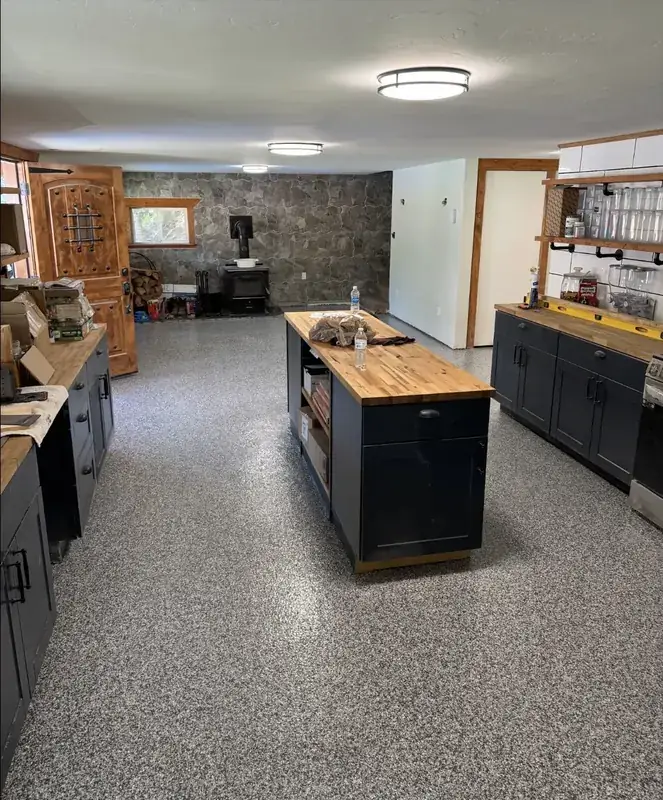
Quotes for a coated garage floor are hard to compare. The floors in the photos look alike, and what differs is mostly out of sight, in the materials, the prep, the crew and the paperwork.
These are the questions to ask any company before you sign, what a good answer sounds like, and how we answer each one. Rhino Coatings installs a polyurea base coat, a flake or silica broadcast and a polyaspartic top coat over diamond-ground concrete. We do not install epoxy.
What should I know before buying a concrete floor coating?
A floor coating is a system of layers bonded to concrete, and the prep under it decides most of how long it lasts. When we are called out to a floor that is peeling or bubbling, the problem almost always traces back to prep, which is why most of these questions are about the slab and the people working on it. Only one is about color.
Do local contractors offer polyaspartic coatings, or mainly epoxy?
You will find both epoxy and polyaspartic or polyurea systems offered in the area. Whatever word a company uses, ask what each layer of its floor is made of, because that is what you are buying.
We do not install epoxy, so if epoxy is what you want, we are not the right call. Our polyaspartic coatings page compares the two.
What is each layer made of?
A good answer names the chemistry of the base coat, the broadcast and the top coat, in plain words. On our garage floor coatings, that is a polyurea base coat, flake or silica hand-broadcast to full refusal, and a UV-stable polyaspartic top coat.
The base coat bonds to the concrete, the flake or silica broadcast into it gives color and texture, and the top coat seals it and takes the wear. A product name alone tells you none of that, so ask what is behind it, and ask whether the broadcast goes to full refusal, meaning it keeps going down until the base coat cannot hold any more. We only install the system; we do not sell the product for do-it-yourself jobs.
How will you prep the slab?
The answer you want is diamond grinding of the whole slab, with any old paint, epoxy or sealer ground off to bare concrete. Ask whether the floor will be ground or acid-etched, and what happens to an old coating.
Grinding takes off the weak top layer so the base coat bonds into the concrete. Acid etching is rinsed off with water, so the slab has to dry out before anything goes on it, as one resin flooring maker notes. Our guide to diamond grinding vs acid etching goes deeper.
We diamond-grind every slab, do not acid-etch, and grind any old coating off to bare concrete as part of the prep instead of coating over it.
How do you handle cracks, joints and moisture?
Every crack and control joint should be repaired before the base coat goes down, with a repair matched to the crack, and someone should check the slab before a date is set. A crack that is still moving should be checked before anything is coated over it, and moisture rising through a slab can push a coating up in blisters. Our guide to moisture in concrete covers what to ask.
We fill cracks and control joints with polyurea that stays flexible through freeze-thaw, repair spalls and pitting, and rebuild damaged edges and thresholds first. At the free estimate we check the slab, including whether a new slab has cured enough to coat. If water is coming through the floor, it needs its own fix first, and we will tell you rather than coat over it. We do not pour, lift or level sunken concrete. The grinding, the repairs and the coating are one job for our own crew, in one written price. Our concrete repair page describes each repair.
When can I walk and drive on it, and what happens in a cold garage?
You can walk on our floors in about 8 hours and drive on them in about 72. Ask any company for both numbers, and ask what changes when the slab is cold.
Coatings cure by chemical reaction, and cold slows it. Most of our garages are done in one day, but a cold slab can lengthen the install day and the cure, so we confirm the walk-on and drive-on timing before we start, or move the date.
The install date is set when you accept the bid, and the lead time depends on the season, so ask for the next open date.
Will your own crew do the work, or a subcontractor?
Ask directly whether the people grinding and coating your floor work for the company you are hiring. Ours do, and every grind, repair and coat is done by our own crew, never by a subcontractor. When the company that sells a floor is not the one that puts it down, a failure can start with an argument about whose fault it was.
Are you registered and insured?
Ask for the contractor's registration number in your state and look it up yourself. Washington requires contractors to register with the Department of Labor and Industries (L&I), with a bond and insurance. Idaho requires them to register with the Idaho Contractors Board, through the Division of Occupational and Professional Licenses (DOPL), with proof of liability insurance. This is a summary of the statutes and agency pages, not legal advice.
In Washington
State law says every contractor shall register with L&I (RCW 18.27.020), file a surety bond (RCW 18.27.040) and carry insurance (RCW 18.27.050), and lets an assigned account stand in for either one. L&I's Verify a Contractor tool shows whether a business has an active registration and workers' comp account, plus safety violations and lawsuits against its bond.
On a home of four or fewer units, or an accessory structure on the property, when the bid or contract price totals $1,000 or more, the contractor must give you a disclosure statement before starting work, with a line for you to sign that you received it, and must keep the signed copy (RCW 18.27.114). The "Notice to Customer" lists the contractor's registration number and bond, warns that the bond might not cover a claim from your job, explains that your property may be liened if a supplier, employee or subcontractor goes unpaid, and tells you that you can ask for lien release documents.
In Idaho
Working as a contractor in Idaho without registering is unlawful under the Idaho Contractor Registration Act (Idaho Code 54-5204), and the Contractors Board's FAQ notes that the act requires registration, not licensure. To register, a contractor shows proof of general liability insurance of at least $300,000, plus proof of workers' compensation insurance or a statement of why it is not required (Idaho Code 54-5210). DOPL's public search lets you look up a registration.
On a home of one to four units, a general contractor must give you a disclosure statement, and get your signed acknowledgment, before entering into a contract of more than $2,000 (Idaho Code 45-525). It tells you that you can require the contractor to get lien waivers from its subcontractors, at your reasonable expense, and can require a surety bond up to the value of the project, at your expense; that you can get proof of its general liability insurance, including completed operations, and of workers' compensation insurance for its employees as Idaho law requires; and that you can buy an extended title insurance policy covering certain unfiled or unrecorded liens.
How we answer
In Idaho, Rhino Coatings is registered with the Idaho Contractors Board, registration 7661574, which you can look up in DOPL's public search. In Washington, we are a registered contractor, RHINOCL741CF, bonded and insured, for our Spokane-area work, and you can check that number with L&I's Verify tool. Whoever you hire, us included, ask for the registration number for your state and check it yourself.
Is the price fixed and in writing, and what does it include?
It should be. Ask for a fixed, written price after someone has measured the floor and seen the concrete, with the prep, the repairs, every layer and the warranty spelled out. A price over the phone or from photos is a guess, because the condition of the slab decides how much grinding and repair it needs.
The FTC's advice on avoiding home improvement scams is to get a written contract even where your state does not require one, listing the contractor's name, address, phone number and license number (in Washington and Idaho, the registration number), estimated start and completion dates, and any promises made in conversation. If you sign it at home, or anywhere other than the seller's permanent place of business, it should also include a written statement of your right to cancel within three business days.
We do not quote over the phone. A rep measures the floor for free, and you get a fixed, written price, usually by email, with no surprise charges on install day. It covers diamond grinding, polyurea crack and joint fill, the polyurea base coat, a full broadcast of flake or silica, the UV-stable polyaspartic top coat and the warranty.
What does the warranty cover, in writing, and who stands behind it?
A good warranty names the failures it covers, says whether labor is included, and tells you who comes back to fix the floor, all in writing with the price, before you sign. A separate guide, what a floor coating warranty should cover, goes through each of these.
Every floor we coat, residential or commercial, carries the same lifetime warranty against peeling, delamination, and hot-tire pickup. It comes in writing with the fixed price, and the same in-house crew that installed the floor stands behind it.
Can I see the colors in my own garage?
You should be able to, because colors look different on a screen than on your own concrete in your own light. Our rep brings flake and silica samples to the free estimate and lays them on your floor. There are 13 flake blends and more than 1,700 silica colors. Flake is the usual choice for a dry garage, and silica grips better when wet.
Can one company do the floor and the garage cabinets?
It can, and if you want both, ask whether the floor goes down first. Once cabinets stand on a slab, the concrete under them cannot be ground or coated without taking the cabinets out.
We do both, with made-in-USA melamine garage cabinets in two series, the Garage Vault and the Tradesman, in 18 colors. The floor goes first, one design visit covers both, one crew does the work, and you get one fixed, written price. Our guide to putting the floor down before the cabinets covers the order and timing.
What do your reviews and past jobs show?
Read reviews where they were posted, look for how the company handled a problem, and ask to see finished floors. The FTC suggests reading reviews with a critical eye and searching the company's name with words like "complaint" and "review," and L&I's Hire Smart guide suggests asking to see a contractor's work or talking with another homeowner.
Our reviews page republishes a selection of customer reviews from Google and Housecall Pro, word for word, each linked to the platform where it was left. We are BBB Accredited with an A rating, and Coeur d'Alene Press readers voted Rhino Coatings Best of North Idaho 2026 for garage floor coatings.
What are the red flags when hiring a floor coating company?
Pressure to sign today, a price that changes on install day and nothing in writing are the clearest, and each moves risk onto you. Most of the signs below come from the warning lists the FTC and L&I publish.
- Pressure to decide now, including a special price that only holds if you sign today.
- A price before anyone sees the floor, or one that changes on install day.
- No written contract or complete bid.
- Cash only, or the full amount up front. The FTC also advises holding the final payment until you are satisfied with the finished work.
- A credential you cannot verify, such as a registration that does not show up in the state's lookup.
- A plan to coat over problems, such as open cracks, a failing old coating or a wet slab.
How do I find the best garage floor coating company near me?
Ask several companies the same questions at your own floor and compare the written answers. L&I's advice on hiring a contractor is to get at least three written bids and compare them carefully, and the FTC advises against automatically choosing the lowest bidder.
We are veteran-owned and coat garage floors across North Idaho and the Spokane area from our Coeur d'Alene shop, with crews on the Washington side every working day, and across the Treasure Valley from our Boise location. For the details where you live, see Spokane, Spokane Valley, Post Falls and Boise.
Residential and commercial floors carry the same lifetime warranty against peeling, delamination, and hot-tire pickup. Book a free on-site measure, ask us every question on this list, and get a fixed, written price for your own floor.