Moisture in concrete: why coatings fail and what to ask any installer
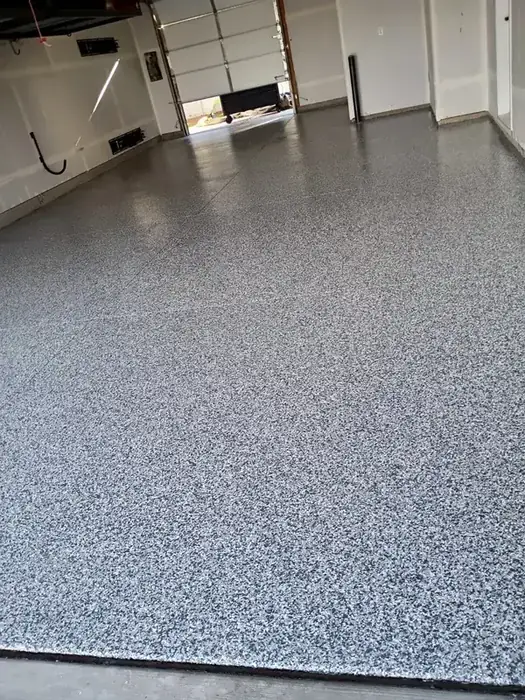
A coating that fails from underneath has a look of its own. It rises in blisters. It lets go in sheets that sound hollow when you tap them. A white powder works its way out along the edges and the cracks. When a floor fails like that, the first place to look is the concrete under it, and one of the most common causes is water moving up through the slab.
Rhino Coatings installs a polyurea base coat with a polyaspartic top coat. We do not install epoxy, and nothing in this guide depends on hiring us. Moisture moves through concrete the same way whatever goes on top of it, so most of what follows applies to any coating. It covers how water gets into a slab, what it does under a coating, the tests the industry uses to measure it, and the questions to ask any installer before a floor goes down.
Concrete is wetter than it looks
Concrete looks solid, but it is full of tiny pores and channels left behind as the cement and water react. Those pores hold water and give it a path to travel. A slab is never completely dry. It is always trading moisture with the ground below it and the air above it, and what matters for a coating is how much moisture is moving, in which direction, and how fast.
Bare concrete handles that traffic without any fuss. Moisture rises, reaches the surface and evaporates, and because it leaves as vapor, you never see it go. The slab looks dry the whole time.
A coating changes the arrangement. It seals the top of the slab, so vapor that used to escape now arrives at the underside of the coating and stops there. Most professional coatings are made to tolerate some of that, up to a limit the manufacturer publishes. Past that limit, moisture collects at the bond line, the thin layer where the coating grips the concrete, and that is where the trouble starts.
Where the moisture comes from
Damp ground under the slab
Most garage and basement slabs sit directly on gravel or soil, and the ground under a slab rarely dries out completely. Water wicks upward through fine soil, and through the concrete itself, much the way a paper towel pulls water out of a puddle. A layer of coarse gravel under the slab slows that wicking, and a plastic sheet under the concrete slows the vapor, but neither one is always there.
Vapor drive
Moisture vapor moves from where there is more of it toward where there is less. Under most slabs the ground is damper than the room above, so that push, which building scientists call vapor drive, points up through the slab and out the top. Temperature plays a part too, which is one reason the same slab can behave differently from one season to the next. A slab on wet ground under a dry, heated room has a lot of vapor headed for its surface.
New concrete
A freshly poured slab holds far more water than the cement needs, and it gives that extra water up slowly through the top surface. Curing and drying run on different clocks. Concrete strength is usually specified at 28 days, which is where the common rule of thumb for coating new concrete comes from, but a new slab can keep giving off moisture well past that, especially through a cold, closed-up winter. Our guide on when you can coat a new concrete garage floor covers the timing in detail.
No vapor retarder under the slab
A vapor retarder is a sheet of heavy plastic laid down before the concrete is poured, and it slows the moisture coming up from the ground. The International Residential Code, the model building code for houses, requires one under concrete floors on the ground, then lists garages and other unheated accessory buildings among the exceptions. So a garage slab may or may not have one, depending on the builder and the local code, and many older basements were poured without one at all. If you have the house plans or can reach the builder, it is a fair question to ask.
Water at the edges and from above
Some moisture arrives from the sides and the top. Downspouts that empty next to the slab, a driveway that drains toward the garage door, and snowmelt running along the foundation all soak the ground at the edges of a slab. Meltwater dripping off a car soaks into bare concrete from above, and so does any water used to wash or prepare the slab.
What moisture does under a coating
Blisters
When vapor reaches the underside of a coating faster than the coating can handle, it gathers in small pockets at the bond line. Pressure builds, and the coating rises into a blister. Some blisters are dry inside and some hold liquid. They often appear first where the most moisture reaches the coating, along cracks and joints or over a patch of ground that stays wet.
Debonding
Moisture sitting at the bond line also weakens the grip between coating and concrete. A coating can let go across a whole area without blistering first. You find out when a section sounds hollow underfoot, lifts at an edge, or peels up in a sheet. In a garage, that loose edge is exactly where meltwater gets in next, and freeze-thaw nights pry it up a little further each time.
Efflorescence
Water moving through concrete dissolves salts out of the cement and carries them along. When it reaches the surface and evaporates, the salts stay behind as a white, powdery or crusty deposit called efflorescence. On bare concrete it is mostly a cosmetic nuisance, though it is proof that water has been moving through that spot. Under a coating the salts have nowhere to go, so they build up at the bond line and can push the coating off from below.
Efflorescence is easy to confuse with dried road salt, which also leaves a white crust. Road salt rides in on the tires and dries where the meltwater pooled, mostly near the door. Efflorescence comes up out of the concrete, often along cracks, joints and the base of the walls, and it comes back after you clean it.
Signs you can see before anyone tests
Each of these is a reason to look closer before a floor is coated, though none of them is a measurement.
- Dark, damp-looking patches that come and go with the weather.
- White powder or crust that returns after you sweep it up, especially along cracks, joints and walls.
- Cardboard boxes that go soft or moldy on the bottom, or rust on the feet of anything metal that sits on the floor.
- A rubber mat, a sheet of plywood or a tarp that is damp underneath while the floor around it looks dry.
- Paint, sealer or an old coating that is bubbling or peeling in places tires never touch.
- A musty smell, which in a basement often points to moisture in the slab or the walls.
- Water at the edges of the slab after a heavy rain or a fast snowmelt.
A slab can show none of these and still carry more moisture than a coating can take, especially a newer one. That is what testing is for.
The tests the industry uses
Flooring and coating professionals have several standard ways to check moisture in concrete. They measure different things, and which one fits depends on the slab, the product going on it and the question being asked. This is an overview of what exists in the industry, not a description of how any one company works.
The plastic sheet test (ASTM D4263)
A square of clear plastic is taped tight to the bare concrete on all four edges, left in place for a set time, then lifted and checked for moisture on its underside or darkened concrete beneath it. As its title says, the standard is a way of indicating moisture in concrete. It gives a quick yes or no signal, and it does not measure how much. A wet result is a clear warning. A dry result is encouraging but less conclusive, because it only shows what happened in that one spot over that one stretch of time.
It is also the one test a homeowner can try. If you do, notice which side of the plastic gets wet. Moisture underneath means it is coming up through the slab. Moisture on top means humid room air is condensing on a cool floor, which is a real problem too, with a different fix.
The calcium chloride test (ASTM F1869)
A small dish of calcium chloride, a salt that pulls moisture out of the air, is weighed, set on a prepared patch of bare concrete and sealed under a plastic dome. After the test period the dish is weighed again, and the weight it gained is converted into a rate, the amount of moisture vapor coming off the slab's surface over a set time. Many flooring and coating manufacturers state their moisture limits in those terms. The standard itself notes that the result reflects the surface of the floor at the time of testing and may not indicate future conditions.
In-slab relative humidity probes (ASTM F2170)
Small holes are drilled partway into the slab and fitted with sleeves, and once the air inside each hole has had time to settle, a probe reads its relative humidity. Because it reads the moisture inside the concrete, it gives a different picture from the calcium chloride test, which measures what is leaving the surface. It is one of the methods flooring and coating manufacturers rely on, and its standard is plain that results describe the slab only at the time of the test and in the specific places tested.
Handheld moisture meters
Meters that press against the surface give an instant reading of roughly the top inch of the slab. They are handy for comparing one part of a floor with another and deciding where to look harder. The ASTM guide that covers them treats the readings as a preliminary, comparative check and says they are not meant as the basis for accepting a floor, pointing to the calcium chloride and relative humidity tests for that.
Every one of these tests describes a slab where and when it was tested. Slabs change with the seasons, the weather, and how the space is heated and ventilated, so a single reading from a single spot is never the whole story.
What happens when a slab reads wet
A high reading means something has to change before the floor is coated, and the options come down to a few.
- Wait. A new slab, or one that was recently soaked, may only need time to dry.
- Fix the source. A downspout, the grading, a leaking pipe or a driveway that drains toward the door can often be corrected, and the slab dries out once the supply stops.
- Match the system to the slab. Coating products differ in how much moisture they tolerate, and the manufacturer's published limits decide what can go down on a given slab.
Water actively coming through a floor or a wall is a different problem from vapor. A coating will not fix active seepage. Water coming up through the slab or in through the walls needs its own fix before any coating goes down, and our rep will flag it at the free estimate.
The time to sort all of this out is before a date is on the calendar. A moisture question is far easier to settle at an estimate than on install day, which is why we check the slab at the free on-site measure, before a floor is ever scheduled.
Prep matters for moisture too
Acid etching, the prep most DIY kits rely on, means wetting the slab, scrubbing acid into it and rinsing it off with plenty of water. The slab then has to dry out again before anything goes on it. We diamond-grind every slab and do not acid-etch. Grinding takes off the weak top layer of the concrete and opens the surface so the polyurea base coat bonds into it.
Moisture also tends to show up where a slab is already damaged. Open cracks and joints give water an easy path, and paint or sealer that is already bubbling is a sign its bond has failed, whether from moisture, poor prep or both. Cracks, spalls and failing coatings get dealt with in the same prep, and our concrete repair page explains how each kind of damage is repaired before a coating goes down.
Questions to ask any installer
- Will you look at the slab before you schedule? A price for a coated floor should come after someone has seen the concrete in person.
- What moisture limit does your product allow? Most professional coating products publish one, and an installer should know the one for theirs.
- How will you know my slab is under it? Ask what they check or test, where on the floor, and whether you will see the result.
- What happens if it reads high? Waiting, fixing a drainage problem or changing the system are all reasonable answers. Coating it anyway and hoping is not.
- Is there a vapor retarder under this slab, and does it matter? You may not know, and neither may they, but a good installer will have thought about it.
- Do you grind or acid-etch? Etching puts water into the slab right before the coating is supposed to go on.
- What does the warranty say in writing? Read the failures it names, not just how long it lasts.
Floors across North Idaho, Spokane and the Treasure Valley
We coat garage, basement, shop and commercial floors from our Coeur d'Alene shop across North Idaho and the Spokane area, and from our Boise location across the Treasure Valley. For the details where you live, see Coeur d'Alene, Post Falls, Spokane and Boise. Basements raise moisture questions of their own, and our guide to basement floors and moisture covers them.
Residential and commercial floors carry the same lifetime warranty against peeling, delamination, and hot-tire pickup. If you have questions about your own slab, book a free on-site measure. We look at the concrete with you, tell you what we see, and give you a fixed written price.