Basement floors and moisture: what works below grade
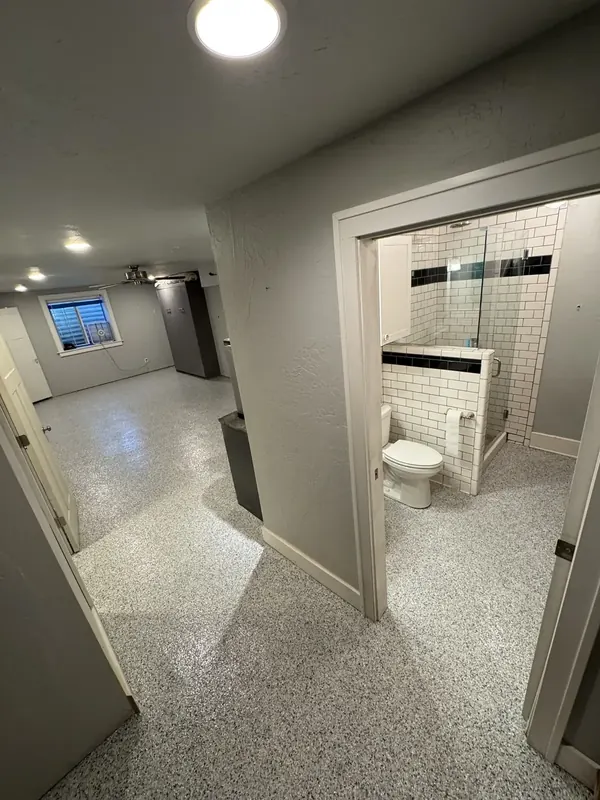
A basement floor is the slab people most want to turn into real living space, and the one they worry about most. It is cold underfoot, it sheds gray dust onto everything stored on it, it may smell a little damp, and in the back of your mind is the question of whether water will come up through it the minute you put something nice on top.
Rhino Coatings installs a polyurea base coat with a polyaspartic top coat. We do not install epoxy. We coat basement floors as well as garages, and this guide covers why a slab below grade behaves differently, what to check and fix before any floor goes down, when a coating makes sense, and what the finished floor gives you.
Why a basement slab is different
A garage slab sits at ground level with open air above it. A basement slab sits in the ground, with soil underneath it and soil pressed against the walls around it. That changes how it deals with water in several ways.
Ground moisture all year
The soil around a basement rarely dries out. Moisture wicks up into the slab from below and moves through it as vapor toward the drier air of the room. A slab poured over gravel and a plastic vapor retarder gets much less of it than one poured straight onto soil, and many older basements were poured without a vapor retarder at all. Our guide to moisture in concrete explains what that vapor does under a coating and how the industry measures it.
Water under pressure
When the soil around a foundation is saturated, after heavy rain, a fast snowmelt or where the water table sits high, water presses against the walls and up against the slab. That is called hydrostatic pressure, and it pushes water through any path it can find, such as cracks in the floor, the joint where the floor meets the wall, and gaps around pipes. A coating is bonded to the top of the slab, which is the wrong side for holding back water that is being pushed up from below. Water under pressure works at the bond from underneath.
Efflorescence
A white, chalky crust on a basement floor or wall is efflorescence, the salts left behind when water carrying them out of the concrete evaporates. It does no harm by itself and it brushes off, but it shows that water has been moving through the concrete in that spot. If it keeps coming back in fresh patches, the water is still moving.
Summer humidity on a cool slab
The ground keeps a basement slab cool. In summer, warm, humid air comes down the stairs or in through open windows, meets that cool concrete and condenses on it, the way water beads on a cold glass. A floor that looks damp on a muggy afternoon may have no leak at all. It is still a moisture problem, and the fix is to dry the air.
Condensation or moisture from below? A simple check
Tape a square of clear plastic tight to the bare floor, sealing all four edges, and leave it for a day. Then lift it. If the underside is wet or the concrete under it has darkened, moisture is coming up through the slab. If the top of the plastic is wet, the moisture came from the room air.
It is a rough check, and it does not measure how much moisture there is. Try it in more than one spot, and again in another season if you can, because a basement in a wet spring can behave very differently from the same basement in late summer. The more precise tests the industry uses are described in our guide to moisture in concrete.
What to check and fix first
Most basement water starts outside the foundation, and that is the best place to stop it. Work from the outside in.
Gutters and downspouts
A roof sheds a lot of water. Gutters that overflow, or downspouts that empty right at the foundation, put that water straight into the soil against the basement wall. Clean gutters and downspout extensions that carry the water well away from the house are among the simplest fixes there are, and a common cure for a basement corner that always seems damp.
Grading
The ground next to the house should slope away from it. The International Residential Code calls for lots to be graded so the ground falls at least 6 inches within the first 10 feet from the foundation. Over the years, settled backfill, raised flower beds and new patios can tip that slope back toward the house.
Window wells, walls and pipes
A window well should drain, so it never holds a pool of water against the window. Inside, look for cracks in the foundation walls with stains below them, damp lines where the wall meets the floor, and gaps around pipes that come through the wall.
Plumbing and appliances
Not all basement water comes from outside. A slow leak at a water heater, washing machine, water softener or utility sink can keep one corner of the slab wet for years. Look under and behind each one.
The sump pump, if there is one
Make sure it runs, that the pit is clear, and that the discharge line carries water well away from the house instead of letting it soak back down along the foundation.
Humidity
Damp air keeps condensing on a cool slab. The EPA recommends keeping indoor humidity below 60 percent, and ideally between 30 and 50 percent (EPA guide to mold and moisture). A simple humidity gauge tells you where the basement stands, and a dehumidifier is the usual fix.
If water is coming in, that comes first
A coating will not fix active seepage. If water is coming through the floor or the walls, that needs its own fix first, and we will tell you rather than coat over it. A coating stops concrete dust. It does not stop water. Stopping water that comes in under pressure is work for a waterproofing or drainage contractor, and it comes before any finished floor, coated or otherwise.
When a coating makes sense
Once water is not coming in and the air is under control, a coating becomes a real option. Older basements can hold more ground moisture, and we take that seriously. We check the slab at the free estimate before we coat.
Rough, patched old concrete can usually be coated. Diamond grinding levels high spots and opens the surface, polyurea fills the cracks and gouges, and the broadcast of flake or silica hides a lot of old scars. We look at the slab in person before quoting, so there are no surprises either way.
A coating also compares well with carpet, the floor covering people often reach for first in a basement. Carpet feels warmer for a season, then it can trap slab moisture and start the musty cycle many old basements know. A sealed coating with rugs where you actually sit gives you warmth where you want it and a washable floor everywhere else, with nothing wall-to-wall holding damp against the concrete.
Signs that water is still getting in, such as fresh damp patches after a storm or efflorescence that keeps coming back in new places, mean the water comes first. A wet underside on the plastic check is worth mentioning too, so whoever looks at the slab knows what you have seen.
What the finished floor gives you
- No more concrete dust. A sealed floor stops the fine gray dust a bare slab sheds onto everything stored on it.
- A brighter room. Light flake blends and pale silica colors bounce back the light you already have, which counts for a lot in a room with small windows.
- A finished look. Smooth silica systems in 1,700+ paint-matched Sherwin-Williams colors suit finished basements, mudrooms and laundry rooms. Flake is the usual choice for a dry basement where the look matters most, and silica grips better when wet, so we recommend it for floors that get wet often.
- A floor that wipes clean. Road salt, brine and deicer ride boots down the basement stairs all winter. On raw concrete they soak in. On the polyaspartic top coat they sit on the surface until you mop.
- Not much downtime. Most basements are coated in a single day, and you can walk on the floor in about 8 hours. Freezers, workout racks and other heavy items wait about 72 hours for the full cure.
It is the same polyurea base coat and polyaspartic top coat we put down in garages, over a diamond-ground slab, installed by our own crews, and the system is laid out layer by layer on our concrete floor coatings page. In the Spokane area there is no job minimum, so a single basement room qualifies.
Questions to ask any installer about a basement floor
- Will you look at the slab and the walls before you price it? Some of the best moisture clues are on the walls.
- What do you see that suggests moisture, and what would you fix first? A good installer will point to specifics, such as a downspout, a damp corner or a crack with efflorescence along it.
- What moisture limit does your product allow, and how will you know the slab is under it? Most professional coating products publish a limit, and an installer should know the one for theirs.
- Do you grind or acid-etch? An acid etch soaks a basement slab with water and acid, then more water to rinse it, right before the coating is supposed to go on.
- What happens to old paint and patches? A new coating is only as good as what it is bonded to.
- What does the warranty say in writing? Read the failures it names, not just how long it lasts.
Basement floors in the towns we serve
Our Coeur d'Alene location coats basement floors across North Idaho and the Spokane area, and our Boise location covers the Treasure Valley. In Spokane, a lot of the basements in older neighborhoods sit on slabs poured generations ago, and our page on basement floor coatings in Spokane covers them. For other towns, see Coeur d'Alene, Spokane Valley and Boise. If your basement slab is new, the timing questions in our guide on coating new concrete apply to it as well.
Residential and commercial floors carry the same lifetime warranty against peeling, delamination, and hot-tire pickup. When the water side is sorted, book a free on-site measure. We check the slab, show you colors on your own concrete, and give you a fixed written price.