Concrete sealer or coating: which does your concrete need?
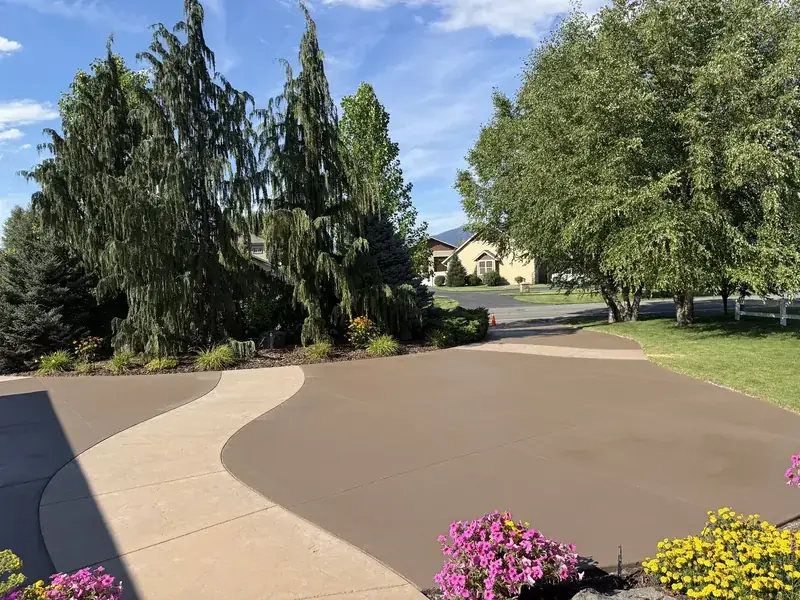
Ask for concrete sealing and the word can cover two different jobs. One is a clear sealer, sprayed or rolled onto bare concrete, that soaks in or leaves a thin film and has to be reapplied as it wears. The other is a coating, a new surface built in layers and bonded to the slab.
Rhino Coatings installs a polyurea base coat with a flake or silica broadcast and a polyaspartic top coat, over diamond-ground concrete. We do not install epoxy. This guide covers what each kind of sealer does, how long it lasts and where it fits, so you can tell what your slab needs before anyone prices it.
In short, a sealer suits concrete you want to keep looking like concrete, such as an outdoor slab left bare, and you reapply it as it wears. A coating replaces the surface, and it is usually what a garage floor that takes hot tires, oil and snowmelt needs.
What is the difference between a concrete sealer and a coating?
A sealer treats bare concrete and wears off. A coating is a finished surface with grip and color, bonded to the slab.
With a sealer, the concrete is still the surface you use, either looking much as it did or under a thin clear film that wears away.
A coating is built in layers on concrete that has been prepared for it. On our floors that means diamond grinding the slab, filling cracks and control joints with polyurea, a polyurea base coat, a flake or silica broadcast to full refusal, and a UV-stable polyaspartic top coat that seals it. The finished surface is non-porous, so oil and spills wipe up with a rag, and road salt and meltwater sit on top instead of soaking in. Our concrete coatings page shows the same system on garages, patios, driveways, basements and shops.
Both jobs can be called sealing, so when you ask for quotes, ask which one you are being offered.
What kinds of concrete sealer are there?
Broadly, there are two families. Penetrating sealers such as silanes, siloxanes and silicate densifiers soak in and work inside the concrete, and film-forming sealers, often acrylics, polyurethanes or epoxies, stay on top. A literature review prepared for the Iowa Department of Transportation sorts them more finely, into water repellents that line the pores, pore blockers that fill them and barrier coatings that cover them.
Silane and siloxane water repellents
Silanes and siloxanes bond to the hardened cement paste and line the pores with a water-repellent layer. Liquid water, and the salt dissolved in it, stays out, while water vapor can still escape, which is why they are sold as breathable sealers. Nothing is left on top, so the concrete keeps its look and texture. One silane maker's product data lists the surface appearance after treatment as unchanged, with the same pendulum slip reading on broomed concrete before and after.
Silicate densifiers
Densifiers are lithium, sodium or potassium silicates that react with the calcium hydroxide in concrete to form calcium silicate hydrate, the main binder in cement paste, inside the pores. The surface gets harder and sheds less dust, according to one maker's densifier data sheet. A Concrete in Practice sheet on dusting (CIP 1) from the National Ready Mixed Concrete Association (NRMCA) recommends a chemical floor hardener such as sodium silicate for a dusting floor, and a coating if the dust persists.
Acrylic, polyurethane and epoxy film sealers
Film-forming sealers leave a clear layer on the surface. The Iowa review lists acrylics, polyurethanes and epoxies as pore blockers or barrier coats, depending on how they are formulated and diluted. Where a sealer leaves a layer on top, that layer is the part that scuffs, wears through where tires roll and turns slick when wet.
In the paving trade, sealcoat is an asphalt product. The U.S. Geological Survey describes sealcoat as the black liquid applied to many asphalt parking lots, driveways and playgrounds to protect the asphalt, so a concrete driveway gets a sealer or a coating instead.
How long does concrete sealer last, and how often should you reseal?
Water repellents and film sealers lose effectiveness over time and need reapplying, and some highway agencies that seal bridge decks plan on doing it every four or five years. How often your own slab needs it depends on the product, the traffic and the weather.
The Iowa review found that sealers lose effectiveness over time and need reapplying at intervals that vary with the product and the weathering. In a survey it summarizes, South Dakota recommended repeating bridge deck sealing at five-year intervals, and Alberta generally planned on a four-year interval. Silane and siloxane sealers break down gradually, as sunlight, abrasion, weathering and the alkalinity of the concrete itself attack the water-repellent molecules.
Film sealers wear fastest where traffic is heaviest. One wet-look sealer's product page warns that horizontal surfaces may be subject to excessive wear and that periodic touch-ups or maintenance coats may be necessary.
With a coating, the question is how long it stays bonded. We do not publish a number of years for our floors, because how long any coating lasts depends mostly on prep, which is why every slab we coat is diamond-ground and its cracks and joints filled with polyurea first.
Is a sealer enough for a garage floor?
Usually not, and one widely sold wet-look acrylic sealer's data sheet says outright that it is not recommended for garage floors. A penetrating sealer slows water and salt, and a densifier cuts dust, but a sealer still leaves bare concrete or a thin film to face hot tires, oil, road salt and snowmelt.
- Hot tires. Film sealers are the ones at risk, and one maker advises against using its wet-look sealer on any surface that sees hot tire traffic. A penetrating sealer has no film to lift, so the tires still ride on bare concrete.
- Oil and spills. A water repellent is made to keep out water and the salt dissolved in it, and oil, brake fluid and antifreeze that soak into bare concrete stain it for good. On a coated floor they sit on top until a rag gets to them.
- Road salt and snowmelt. Penetrating sealers are used on highway concrete to keep water and chlorides out, and research for the Iowa DOT concluded that sealers can help concrete surfaces last longer. In Wisconsin Highway Research Program lab tests on bridge deck sealants, though, freeze-thaw cycles reduced the ability of most of them to limit chloride ingress. Our guide to road salt and deicer damage on garage floors covers the rest.
- Dust. A densifier hardens the surface and cuts dusting, and a film sealer covers it while the film lasts. A coating seals the concrete for good, so the fine gray dust stops landing on tools, totes and cars.
- Wet floors. Smooth concrete and glossy sealers get slick the moment they are wet. One wet-look sealer's product page cautions that sealed surfaces may become slippery when wet. Every floor we coat gets a full broadcast of flake or silica, so the grip is built into the floor.
A garage that parks cars through a North Idaho winter is what our garage floor coatings are built for, with a surface that resists hot-tire pickup, oil and road salt.
When should you seal concrete instead of coating it?
Seal it when you want it to stay bare concrete. That covers an outdoor slab that should keep its broom finish, a driveway or walk you are happy to maintain, and new outdoor concrete heading into its first winter.
Scaling is the flaking that freeze-thaw causes on outdoor concrete and deicers make worse, and NRMCA's Concrete in Practice sheet on scaling (CIP 2) recommends protecting slabs exposed to freezing and deicers with a breathable silane or siloxane sealer or water repellent made for concrete slabs. It says the concrete should be reasonably dry first and names late summer, after a few dry days, as an ideal time. The same sheet says to avoid deicing chemicals through the first winter, use clean sand for traction, and use deicers in moderate amounts after that.
On new concrete, our guide on when you can coat a new concrete garage floor covers how long a slab needs before a coating. For an outdoor slab you mean to leave bare, a breathable sealer before the first winter follows the NRMCA advice. If you might coat that slab later, note what went on and when and tell the rep, because a sealed slab takes more grinding before it is coated.
For a driveway, it comes down to whether you want a treated driveway or a finished one. A sealer treats the concrete. A coating gives it a finished surface with grip and color, and our page on patio, porch and pool deck coatings explains how outdoor concrete is coated and why we recommend silica wherever a surface gets wet.
Basement floors
For a basement, a densifier cuts the dust a bare floor sheds and a coating seals it in, but neither fixes water coming up through the slab or in through the walls. The silane maker linked above says its sealer will not stop water coming through cracked or unsound concrete, and a coating will not fix active seepage either. That needs its own fix first, which is why we check basement slabs at the free estimate before we coat.
Can you put a coating over sealed concrete?
Not directly. A sealer has to come off before a coating goes down, the same as old paint or epoxy, and on our jobs it is diamond-ground off to bare concrete as part of the prep.
A coating is only as good as the concrete under it, and the base coat needs clean, open concrete to bond into. Coating manufacturers treat a sealer as a contaminant. One major resin flooring maker's surface preparation guide lists sealers with oil, grease, wax, curing compounds, laitance and salts as bond-inhibiting contaminants to remove for a good bond.
A sealed slab can still be coated, and it takes more grinding, like a floor with old paint or epoxy on it. If you know what was applied, or roughly when, tell the rep at the estimate and the rep will check it on site. That includes any cure-and-seal product the concrete crew sprayed on a new slab. Our concrete repair page shows how a slab is ground and repaired before it is coated.
What is a polyaspartic sealer?
The name covers two different things. Sometimes it means a clear polyaspartic coat rolled straight onto concrete, and sometimes the clear polyaspartic top coat of a broadcast floor. Both use the same family of chemistry, and they make very different floors. One product sold under that name is described by its seller as a high-gloss polyaspartic sealer for interior concrete that can also serve as the base coat and top coat over a chip or sand broadcast.
Polyaspartic is a type of polyurea, and it makes a good top coat because it is UV-stable and does not yellow in sunlight. Rolled onto bare concrete as a clear coat, it has the same two weak points as any film sealer. Its bond depends entirely on the prep under it, and a smooth clear film can be slippery. One polyaspartic kit maker's instructions warn that any coated surface, especially a smooth one, can be slippery when wet or oily, and recommend mixing the included grit into the clear top coat.
On our floors, polyaspartic is the last of three layers, over a polyurea base coat that bonds into the diamond-ground concrete and a flake or silica broadcast to full refusal that puts the texture in the floor. Our polyaspartic coatings page explains why each layer is made of what it is.
So if a quote says polyaspartic sealer or polyaspartic seal coat, ask what goes under it, how the slab will be prepped and whether there is a broadcast. The answers tell you whether you are buying a clear coat on bare concrete or a full system.
Where can you get a free coating estimate?
Our Coeur d'Alene shop does free on-site measures across North Idaho and the Spokane area, including Coeur d'Alene, Hayden, Post Falls, Dalton Gardens and Rathdrum, and our Boise location covers the Treasure Valley. The rep checks the slab for cracks, spalls and old sealer, and you get a fixed, written price. Rhino Coatings is veteran-owned, and our own crews handle every step.
Residential and commercial floors carry the same lifetime warranty against peeling, delamination, and hot-tire pickup. Book a free on-site measure to have the slab checked and get a fixed, written price.