Road salt, brine and deicer: what winter does to a garage floor
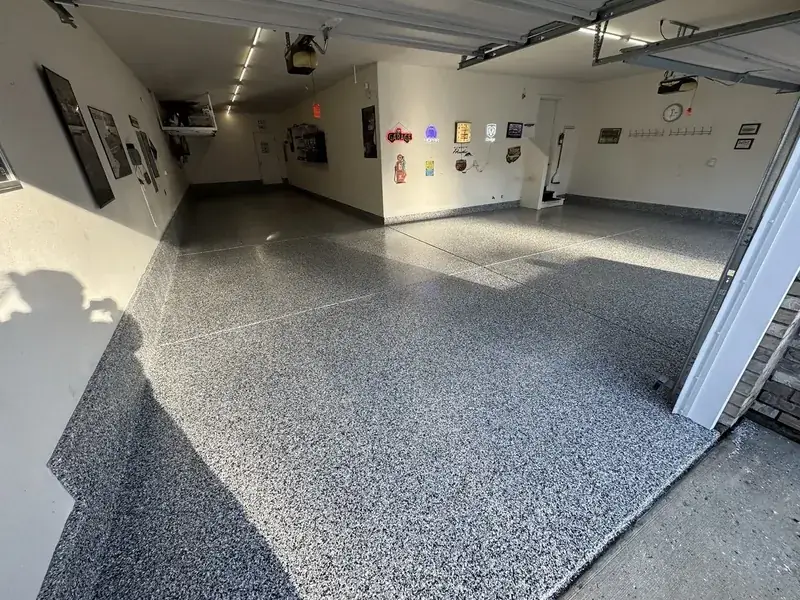
By March, a lot of garage floors in this part of the country have the same look: a white crust where the meltwater dried, a gritty film that never quite sweeps up, and, on older slabs, a rough patch near the door where the surface has started to flake away. All of it came home on the tires.
This article is about what that salt and water do to concrete, how to slow the damage, and what a coated floor needs to stand up to it. Rhino Coatings installs a polyurea base coat with a polyaspartic top coat over diamond-ground concrete. We do not install epoxy, and nothing here depends on buying a floor from us. The winter routine near the end works on any garage.
Where the salt comes from
Roads in the Inland Northwest get treated all winter. Spokane County, to take one example, follows its plows with traction sand mixed with road salt and a granular deicer, and applies a liquid deicer to busier arterials when the weather calls for it (Spokane County winter road maintenance). Other road crews in the area lean on salt as well, so it does not much matter which roads you drive. By the end of a commute, the car is carrying some of it.
Every trip on treated roads loads the tires, wheel wells and underbody with slush, salt and sand. Park in a garage that is warmer than the street and that load melts off onto the floor. The water runs to the low spots and sits, and when it finally evaporates the salt stays behind as that white crust. Do that through a whole season and the floor has been soaking in salt water for months.
What salt and freeze-thaw do to bare concrete
Concrete looks solid, but it is full of tiny pores, and water gets into them. When that water freezes it expands and presses on the concrete around it. One freeze does nothing you can see. Dozens of them a winter, year after year, break down the top layer until it starts coming off in flakes and chips. That surface loss is called scaling, and when bigger pieces pop out it is called spalling.
The climate here supplies plenty of those cycles. In Coeur d'Alene, NOAA's 1991 to 2020 normals put the average January high at 36.2°F and the low at 26.2°F, and Spokane's January runs a high of 34.5°F and a low of 24.7°F. Through the middle of winter, the concrete just inside the door can cross the freezing line nearly every day.
Salt makes this worse in a few ways. It keeps the surface wet longer, so water stays in the pores through more cold nights. It melts ice that would otherwise have stayed frozen, so the surface goes through more freeze and thaw cycles than it would on its own. And road salt and deicer attack the cement paste in bare concrete and speed up spalling, which is how a bare driveway ends up shedding gravel in spring. A garage floor takes the same punishment, concentrated in the first few feet inside the door, where the car drips the most.
How to tell a floor is losing the fight
- The surface near the door turns rough and sandy while the back of the garage stays smooth.
- Small pits appear where the stones in the concrete start to show through.
- The edges of cracks and control joints crumble and widen.
- A white residue comes back no matter how often you sweep.
None of these means the slab has to be replaced. They mean the surface is being worn away and will keep wearing until something stops the water and salt from reaching it.
What salt does to a coated floor
A coating changes the problem completely, as long as it stays bonded. Water and salt can only damage the concrete if they reach it, and a well-bonded coating keeps them on top.
The weak points are the same ones that sink a thin epoxy floor in this climate. A thin coating over concrete that was etched rather than ground lets salt water in at chips, edges and cracks, where it freezes, lifts the coating a little and lets in more water the next time. A rigid coating cracks along with the slab and opens a new path every time it does. That is why the way a floor is built matters more than the name on the bucket: diamond grinding so the base coat bonds into the concrete, polyurea in the cracks and joints so the repair flexes through freeze-thaw, a flexible polyurea base coat, and a chemical-resistant polyaspartic top coat.
On a floor built that way, road salt and deicer sit on the surface until you rinse or squeegee them out the door. The salt does not go away by itself, so the floor still needs a winter routine, but the concrete underneath stays out of the fight.
What about a concrete sealer?
A clear penetrating sealer is the budget answer people usually find first, and it is not a bad one. It soaks into the top of the slab and makes it absorb less water, which slows down scaling. What it does not do is give the floor a new wear surface. The concrete you walk and park on is still bare concrete, so oil still stains it, salt crust still has to be scrubbed off it, and the sealer itself wears away and has to be reapplied every few years to keep working.
A coating and a sealer solve different problems. If the floor is in good shape and you mainly want to slow down winter wear, a sealer buys time. If you want a surface that keeps salt and oil on top for years, cleans with a squeegee and looks finished, that is a coating, and it has to be built on ground, repaired concrete to hold up here.
A winter routine that works on any garage floor
- Move the water out early. After a storm, push the meltwater out the door with a squeegee before it soaks in or dries into a crust.
- Rinse the salt off. When the weather allows, rinse the floor with water and a mild soap. Dried salt and sand are abrasive, and grinding them in with your boots wears any surface faster.
- Knock off the slush outside. Clearing packed snow from the wheel wells before you pull in keeps a lot of salt water off the floor in the first place.
- Use mats, and lift them. Containment mats catch a lot of meltwater, but they need emptying, and the floor under them needs to dry out between storms.
- Keep the path to the door clear. Water should be able to leave the garage instead of pooling against the walls or under shelving.
- Do a real clean in spring. Once the roads are dry, a thorough rinse and scrub takes the season's salt and sand off the floor before it gets ground in all summer.
The apron and the driveway take it too
The concrete just outside the garage door often looks worse than anything inside. It gets the same salt water, plus direct snow, plows of slush from the street and full sun on the thaw. If the apron or the driveway is already scaling, it is worth looking at it in the same visit as the garage floor. Exterior slabs usually need repair first, then a full diamond grind, and they get a finish chosen for grip when wet. Our patio and walkway coatings page covers how outdoor concrete is handled.
Repairing salt damage before a coating
A floor that already shows scaling or spalling is not a lost cause. Damaged concrete gets repaired as part of the coating project. We diamond-grind the surface, fill cracks and joints with polyurea, and rebuild spalled and pitted spots so the base coat has sound concrete to bond to. Edges and thresholds, where salt damage is usually worst, can be rebuilt as well. More on that work is on our concrete repair page.
What does not work is coating straight over loose, flaking concrete. The new coating would be bonded to a surface that is still coming apart, and it would come up with it. If a floor is past the point of repair, a good installer should tell you so at the estimate rather than coat it anyway.
Garage floors in the towns we serve
We coat garage floors across North Idaho and the Spokane area from our Coeur d'Alene shop, and across the Treasure Valley from our Boise location. For what that looks like in your town, see Spokane, Spokane Valley, Liberty Lake, Coeur d'Alene, Post Falls, Hayden and Sandpoint, or read how each layer of a garage floor coating goes down.
Residential and commercial floors carry the same lifetime warranty against peeling, delamination, and hot-tire pickup. A free on-site measure is the place to start: we look at the slab, the damage and the repair it needs, and give you a fixed written price.