Garage floor paint vs a coating: what lasts on a garage floor
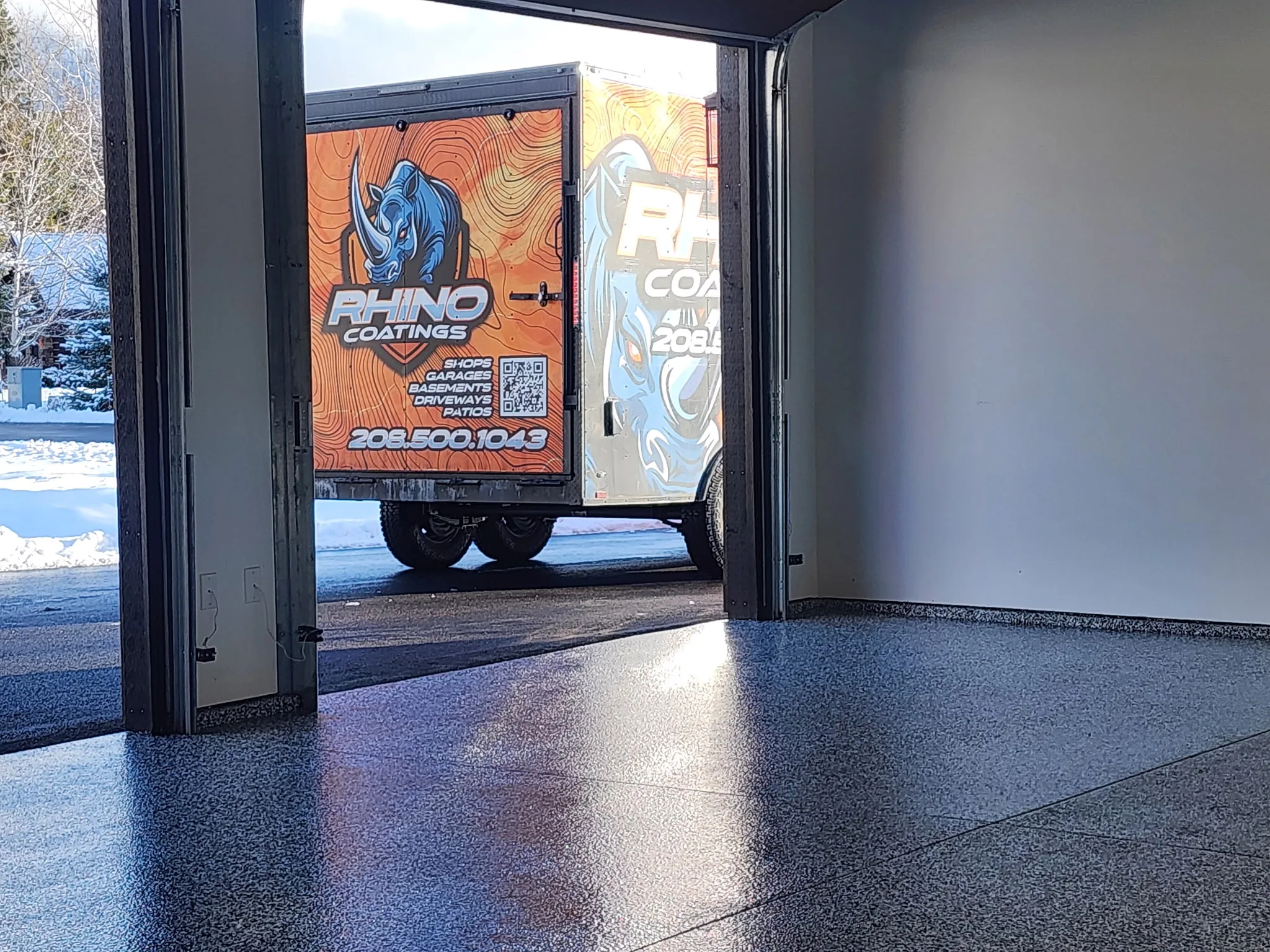
On a garage floor you park on, a coating system bonded to ground concrete outlasts floor paint. Paint dries to a thin film from a single can. The two one-part garage floor paint labels we read ask you to keep tires off for a week, and one warns that the tire paths may need touching up every year. Paint still has a place, on floors that never see a car.
Rhino Coatings installs a polyurea base coat, a broadcast of flake or silica and a polyaspartic top coat over diamond-ground concrete. We do not install epoxy, and we only install; we do not sell paint, kits or the coating product. This guide goes by the labels and data sheets of widely sold floor paints.
What is garage floor paint?
Garage floor paint is a one-part paint made for concrete floors, and every one we read is water-based. It comes ready to use, so you stir it, roll it on and let it dry. Floor paints come in two main families, porch and floor enamels and one-part "epoxy" floor paints, and the data sheets we read for both list acrylic resins.
Porch and floor enamel
The two porch and floor enamels we read are latex paints for porches, steps, patios and basements. One widely sold porch and floor enamel's data sheet describes it as a waterborne acrylic, lists a dry film of 1.5 mils per coat (a mil is a thousandth of an inch), and says it is not suitable for garage floors or for surfaces that take car or truck traffic. Another maker's floor and patio enamel is an epoxy-modified acrylic latex recommended for basements, porches and patios, and its data sheet warns that many tires contain compounds that can attack latex paint, so it loses adhesion and lifts.
One-part epoxy floor paint
One-part epoxy paints are the floor paints marketed for garages. One maker's data sheet calls its version a single-component, water-based epoxy, lists the resin as acrylic and epoxy, gives 1 to 1.6 mils of dry film per coat, and says not to apply more than two coats. Another maker's product page says its one-part epoxy resists peeling caused by hot tires, and its directions add that the tire paths may need a touch-up every year.
Epoxy as a floor coating is a two-part product, a resin and a hardener that react when they are mixed, and that is what most garage floor kits hold. Our guide to what DIY epoxy kits actually last covers those.
How is floor paint different from a coating system?
A coating system cures by chemical reaction into a hard film that is built up in layers and bonded to ground concrete. Paint dries to a thin film on concrete that has been cleaned and etched.
Chemistry
Floor coating systems are typically built from two-component products. The two parts are mixed just before they go down and react into a hard, chemical-resistant film. The floor and patio enamel's data sheet lists how that paint dries, by evaporation and coalescence, the same way a latex wall paint does.
Film build
Paint goes on at a mil or so per coat, usually in two or three thin coats, and one label caps it at two. A broadcast system like ours builds its thickness in layers, a base coat, a full broadcast of flake or silica and a top coat, with multiple coats matched to how the floor is used. That is far more body than a rolled coat of paint, and more to wear through before scuffs, chips and hot tires reach the concrete.
The broadcast
On our floors, flake or silica is broadcast by hand into the wet base coat to full refusal, until it will not take any more, and the top coat seals it in. Flake gives the floor texture and depth and hides dust and tire marks. A painted floor is usually a single solid color, with grip only if an additive is stirred in.
Prep
The paint labels we read prep bare concrete by cleaning it and etching it with an acid, often muriatic, to a texture like sandpaper, and two of them skip the etch on a slab that is already rough. We diamond-grind every slab instead, we do not acid-etch, and cracks and control joints are filled with polyurea before the base coat goes down. Grinding takes off the weak top layer of the slab and any old sealer with it. Acid cannot dissolve curing compounds or oily deposits, according to one resin flooring maker, and one of the paint labels says not to etch painted surfaces at all. Our guide to diamond grinding vs acid etching covers the difference, and how each layer goes down is on our garage floor coatings page.
Why does garage floor paint peel?
Garage floor paint usually peels because a thin film is holding onto concrete against hot tires, moisture coming up through the slab and salty snowmelt, and sooner or later one of them wins.
Hot tires
A warm tire parked on a soft, thin film can grip it harder than the film grips the concrete, and when the car backs out the paint leaves with the tire. The floor and patio enamel's data sheet lists film pickup from tires as a limitation of latex paint, and blames compounds in the tires themselves. We explain the mechanism in hot-tire pickup: what it is and how to prevent it.
Moisture from below
Concrete passes moisture up from the ground, and a thin film on top can blister and lift as it does. Both one-part epoxy paints say not to use them on areas subject to hydrostatic pressure, and the porch and floor enamel's data sheet has you tape a two-foot square of plastic to the bare slab, wait 48 hours, and find and fix the source of any moisture that shows up under it before painting.
A thin film and the prep under it
At a mil or so per coat, there is not much paint between the concrete and a dropped tool, a dragged floor jack or a tire. Once a chip opens, water and grit work in under its edges. How long the film holds also depends on the prep under it. When we are called out to a floor that is peeling or bubbling, the problem almost always traces back to prep that was not done with industrial diamond grinders.
Snowmelt and salt
Through an Inland Northwest winter, cars bring home slush laced with road salt, and the meltwater sits on the floor near the door. Water that finds a chip or an edge gets under the film, and freezing and thawing pry it up a little more each time. Both one-part epoxy labels also say to wait 30 days before rinsing or cleaning a new paint job, and one ties that wait to full cure, a long time in a garage taking snowmelt.
How long before you can drive on a painted garage floor?
The one-part garage floor paints we read say to wait 7 days before driving on them, and the porch and floor enamel we read is not meant to be driven on at all. Most garages we coat are done in a day, and you can walk on the floor in about 8 hours and drive on it in about 72, once the top coat has fully cured.
One of the one-part epoxy paints allows light foot traffic after 24 hours. Both ask for 72 hours before heavy foot traffic or moving furniture back and 7 days before car tires. One of them allows tires on corrugated cardboard after 72 hours if necessary, and warns that heavy traffic too early will cause the paint to fail. The porch and floor enamel lists 24 hours for light foot traffic and 7 days for tables, chairs and heavy foot traffic, and rules out vehicles entirely. Every label we read also ties drying time to temperature and humidity.
The paint labels want temperatures of at least 50°F when the paint goes on, and three of the four we read set a ceiling of 90°F. In an unheated garage here, the slab can stay colder than 50°F for long stretches between fall and spring. Cold slabs can lengthen our install day and the cure as well, so we confirm the walk-on and drive-on timing before we start, or move the date.
Can you put a coating over painted concrete?
Yes, once the paint comes off. We do not coat over an old coating. The paint is diamond-ground off to bare concrete, so the polyurea base coat bonds to the slab itself instead of to a film that can still let go.
A new coating is only as strong as the layer under it. Paint bonded to an etched slab, or already lifting at the door, would take the new floor with it when it lets go. Even the porch and floor enamel's data sheet, in its directions for repainting, notes that anything short of total removal of the old coating may shorten the service life of the new one.
A floor with paint on it takes more grinding than a bare one, which the rep looks at during the free estimate, so tell us what is on your floor now.
When does garage floor paint make sense?
Paint makes sense on a floor that never sees a tire, when you want a cleaner look for less money and do not mind touching it up. The labels point the same way. One floor enamel is recommended for basements, porches and patios, and the other rules out garage floors outright.
- A storage-only garage. If nobody parks inside and the floor holds bikes, totes and a workbench, paint never meets the hot tires that lift it.
- A basement or a shop corner. A laundry area, a home gym or the corner of a shop where no car parks is close to what floor enamels are made for. Check for moisture first, since the labels rule out slabs with water pushing up through them. A coating will not fix active seepage either; water coming through a slab needs its own fix first.
- A refresh before you sell. A fresh coat makes a tired garage look clean for listing photos and showings. The next owner inherits a painted floor, and if they want a coating later, the paint gets ground off first.
Paint is a harder bet in a garage where you park every day, where winter brings salt and meltwater in on the tires, or where the slab has a moisture problem or a sealer on it. If you do paint, follow the label to the letter: the temperature range, the moisture test, the prep and the full wait before cars.
Is polyaspartic paint a real thing?
Not really. Most polyaspartic floor coatings are two-component products, a resin and a hardener that react once they are mixed, so they come as two parts combined right before use, unlike a one-part floor paint. A few makers do sell single-component versions.
Covestro, a chemical company that makes polyaspartic resins for coating manufacturers, describes its polyaspartic coating technology as two-component systems built from polyisocyanates and aspartic resins. "Paint" is the everyday word for anything that colors a floor, so a search for polyaspartic floor paint usually means a polyaspartic coating.
Polyaspartic, a type of polyurea, is the top coat on our floors. It goes over a polyurea base coat and a full broadcast of flake or silica, it is UV-stable so it does not yellow in the sun by the door, and it resists hot-tire pickup, oil and road salt. We only install; we do not sell the product. If you searched for Rhino floor paint, there is no paint or kit from us to buy.
Is painted concrete slippery?
It can be, especially when it is wet, and the labels say so. Three of the four we read warn that painted floors may be slippery when wet and suggest stirring an anti-slip additive or aggregate into the paint.
One data sheet adds that an additive will not eliminate the risk of slipping. That matters in a garage, where snowmelt drips off the car all winter onto a smooth painted surface. On our floors, the grip comes from the broadcast. Every floor gets a full broadcast of flake or silica and a slip-resistant polyaspartic top coat. Flake is the usual choice for a dry garage. Silica grips better when wet, so we recommend it for patios, walkways, pool decks and floors that get wet often.
Looking for someone to paint your garage floor?
If you are weighing paint against a coating, the coating is what we install, from our Boise location across the Treasure Valley and from our Coeur d'Alene headquarters across North Idaho and the Spokane area. Rhino Coatings is veteran-owned, and our own crews do every step, from the grinding and repairs to the top coat. For the details where you live, see Boise, Meridian, Nampa and Spokane.
Residential and commercial floors carry the same lifetime warranty against peeling, delamination, and hot-tire pickup. If your garage floor is bare, painted or already peeling, book a free on-site measure. The rep checks the slab and whatever is on it, lays flake and silica samples on your own concrete, and gives you a fixed, written price.