What DIY epoxy kits actually last
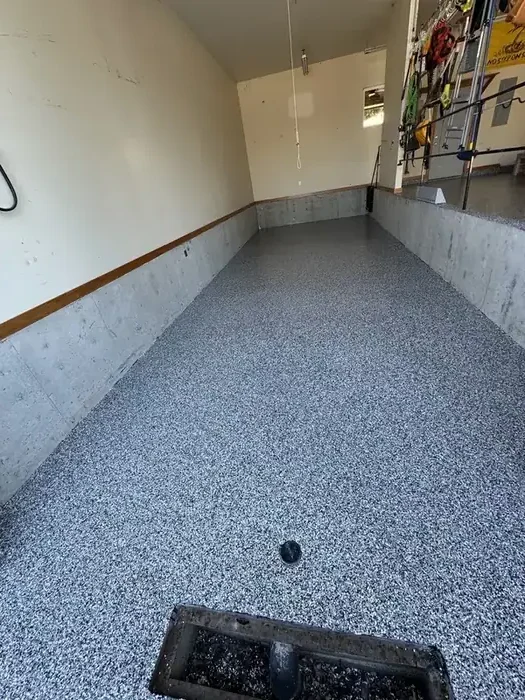
A garage floor kit is an appealing project. One box, a free weekend and a roller, and the floor goes from dusty gray to something that looks finished. The question most people have before they buy one is how long it will last.
Rhino Coatings installs a polyurea base coat with a polyaspartic top coat. We do not install epoxy, and we do not sell any product for do-it-yourself jobs, so we have no kit of our own to recommend. We are also not going to give you a number of years, because no one can honestly put a number on a floor they have not seen. What we can do is explain what a kit is, how kit floors fail in a garage, what decides how long one lasts, and when a kit makes sense.
What a kit is
Most garage floor kits hold the same few things: a two-part epoxy that you mix, a cleaner or etching solution for the concrete, a bag of decorative chips and a set of instructions. Some products sold for garage floors are one-part coatings, closer to a tough paint than a two-part epoxy, so read the box closely. The details that matter most about any kit are printed on the label.
A thin film
A kit is designed to be rolled on by hand, often in a single coat, and the thickness you end up with is whatever the roller leaves behind. The coverage printed on the box sets that thickness. Stretch one kit across a bigger floor than it was meant for and the film gets thinner still.
An acid etch for prep
Kits usually rely on an acid etch rather than grinding to prepare the concrete. The etch cleans and roughens the surface so the coating has something to grip, and then it has to be rinsed off thoroughly and the slab left to dry before coating. An etch cannot get through a sealer, a curing compound, ground-in oil or an old coating. We open every slab with diamond grinders instead, which take the surface down mechanically to clean, sound concrete.
A short pot life
Once the two parts are mixed, the reaction starts and the clock runs. The label gives a working time, and after it the batch thickens whether or not it is on the floor yet. Heat shortens that window, so a hot garage gives you less time than you might expect.
Temperature limits
The label also gives a temperature range, for the air and usually for the concrete too. Below it, epoxy cures slowly or incompletely. Above it, the working time shrinks. In an unheated garage in the Inland Northwest, the slab can stay cold for weeks at a time between fall and spring, so the stretch of the year when a kit can go down inside the label's range is shorter than the calendar suggests.
The label will also say how long to wait before driving on the floor. Take that wait seriously, and allow longer if the garage is cool.
How kit floors fail in a garage
None of these failures is unique to kits. Any thin coating over poorly prepared concrete is exposed to them. Kit floors tend to meet several at once, because a thin film over an etched slab is exactly what most of them exploit.
Hot-tire pickup
A warm tire parked on a thin, soft coating can bond to it, and when the car backs out the coating comes up in the shape of the tread. It is the failure that gave garage coatings a bad name, and thin coatings over poorly prepared concrete are the classic case. We explain the mechanism, plasticizers and all, in hot-tire pickup: what it is and how to prevent it.
Peeling at the door
The first few feet inside the garage door take the most water, salt, sun and tire traffic, and the edge of the coating at the threshold is where water finds its way underneath. Once water gets beneath a thin film it works the coating loose a little at a time, which is why kit floors often start peeling at the door and spread inward.
Salt and freeze-thaw
Through an Inland Northwest winter, cars come home carrying slush laced with road salt and deicer. The meltwater sits on the floor, and the concrete near the door crosses the freezing line again and again. Salt water that gets into a chip or a crack freezes, pries the film up a little and lets more water in next time. A rigid film over a slab that moves with the temperature also tends to crack along with it.
Yellowing
Most epoxies amber in sunlight, and the strip by the door, where the sun comes in, goes first. It is cosmetic, and it is permanent. Our guide on why epoxy yellows, and what does not explains the chemistry.
What decides how long a kit lasts
Two garages can use the same kit and get very different results. Prep matters most. Thickness decides how much the floor can take, and use and climate decide how hard it gets tested.
Preparation
The concrete has to be clean, free of oil and sealers, sound at the surface and dry, and the etch has to reach all of it evenly. Moisture coming up through the slab is a common hidden problem. The plastic sheet test (ASTM D4263), where a square of plastic is taped tightly to the slab and checked later for moisture underneath, is a rough first check. It can flag a problem, but a dry result does not prove the slab is dry enough. When we are called out to a floor that is peeling or bubbling, the problem almost always traces back to prep that was not done with industrial diamond grinders.
Thickness
More film gives a floor more body against hot tires, scuffs and water at the edges. A kit applied at the coverage on the box, in the coats the instructions call for, does better than one stretched to finish the job.
Use
A kit floor in a garage where nobody parks, or a workshop where the heaviest traffic is a rolling stool, is tested far less than one under a daily driver that comes home hot from the highway in July. Heavy things dragged across the floor, dropped tools and spilled chemicals all add to the wear.
Climate and timing
A kit rolled onto a cold slab in October is fighting the calendar from the first day. After that, salt, freeze-thaw and sun through the open door test it every year it stays down.
Put those together and the range is wide. A kit on a clean, dry, well-prepared slab, in a garage that sees no cars and little sun, can look good for a long time. The same kit rolled thin over an etched slab, under a daily driver, in a garage that takes salt all winter and sun all summer, is set up to fail early.
For our own floors, we do not publish a number of years either, because how long any coating lasts depends mostly on prep. That is why every slab we coat is diamond-ground and its cracks and joints filled with polyurea first.
When a kit is a reasonable choice
A kit can be a sensible way to coat a floor, as long as the floor matches what a kit can do. Epoxy is a proven coating, and it can suit an indoor floor that never sees sunlight or hot tires.
- Floors without cars. A workshop, a storage room or a garage used as a home gym takes no hot tires and far less water and salt.
- Floors out of the sun. A floor the sun never reaches will not grow an amber band by the door.
- A dry, sound slab. No moisture problem, no sealer and no old coating to get through.
- The right weather. A stretch of days when the air and the slab sit inside the label's range, with time for the slab to dry after the etch.
- Clear expectations. If you want a cleaner-looking floor on a tight budget and are ready to touch it up or redo it later, a kit is a fair trade.
A kit is a harder bet in a garage where you park every day, where winter brings salt and meltwater in on the tires, or where the slab has a moisture problem, a sealer or an old coating on it.
If you do use a kit
- Read the whole label before you buy. Check the temperature range, the working time, the coverage and the wait before driving on it, and make sure your garage and your calendar fit them.
- Check for a sealer. Sprinkle some water on the slab. If it beads up instead of darkening the concrete, something is sealing the surface, and an etch will not get through it.
- Check for moisture. Run the plastic sheet test, and treat a damp result as a reason to stop and find out more.
- Get the oil out. Degrease thoroughly, especially where cars have parked for years.
- Consider grinding instead of etching. Many tool rental shops rent floor grinders. Grinding concrete raises fine crystalline silica dust, and OSHA's construction silica rule lists floor grinders among the tools that need dust controls, so use one with a vacuum attached and wear a proper respirator (OSHA respirable crystalline silica standard).
- Mix only what you can spread in time. Work in batches you can get onto the floor well inside the working time.
- Do not stretch the coverage. Buy enough material for your floor at the rate printed on the box.
- Wait out the cure. Keep cars off for the full time on the label, and longer in a cool garage.
When a kit floor fails
Rolling a fresh kit over a failing one does not fix the cause. The new coat bonds to the old one, the old one is still poorly bonded to the concrete, and a new coating is only as strong as the layer underneath it.
A failed kit floor gets the same treatment from us as any old coating. We do not coat over failed epoxy, we remove it. The same diamond grinding that prepares any slab takes the old coating down to bare concrete, including the parts that are still stuck, along with any sealer or contamination underneath. Cracks, joints and spalls are repaired. Then the polyurea base coat goes down, flake or silica is broadcast to full refusal, and the polyaspartic top coat seals it. Most garages are done in a day, and you can walk on the floor in about 8 hours and drive on it in about 72.
A floor with an old coating takes more grinding than a bare one, which is one of the things the rep looks at during the free estimate. If you still have the kit box or know the product, tell us. The rep will check the floor either way.
Garage floors in the towns we serve
We coat garage floors, including ones with old kits on them, from our Coeur d'Alene shop across North Idaho and the Spokane area and from our Boise location across the Treasure Valley. See Spokane Valley, Post Falls, Hayden and Nampa, or read how each layer of a garage floor coating goes down.
Residential and commercial floors carry the same lifetime warranty against peeling, delamination, and hot-tire pickup. Whether you are weighing a kit or looking at one that has started to peel, a free on-site measure gets you a look at the slab, colors on your own concrete and a fixed, written price.