Why epoxy yellows, and what does not
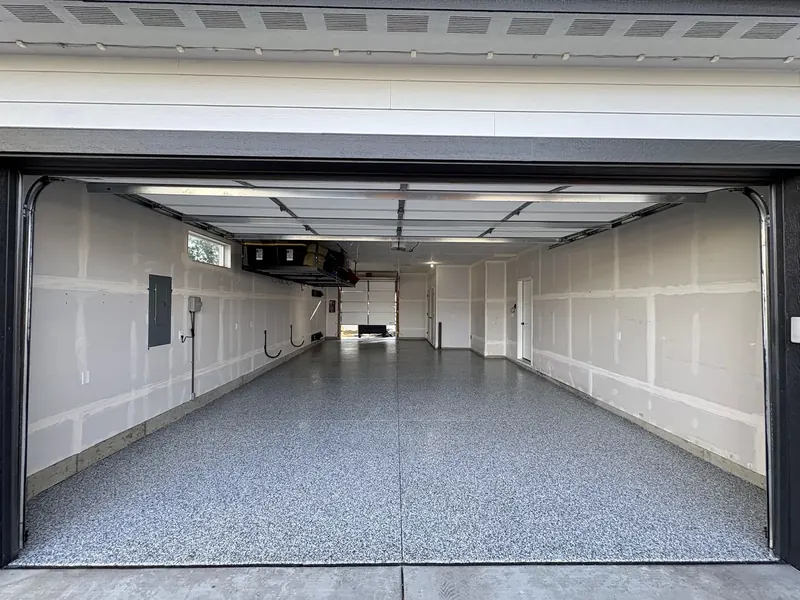
Once you have seen it, it is easy to spot. An epoxy garage floor that was bright gray, white or a crisp flake blend when it went down has a band of honey or amber color by the door some months or years later, while the back corner still looks close to new. Scrubbing does nothing, because the color is in the coating itself.
Rhino Coatings installs a polyurea base coat with a polyaspartic top coat. We do not install epoxy, and yellowing is one of the reasons. This guide explains why most epoxies yellow, why the strip by the garage door goes first, which coatings hold their color, and what you can and cannot do about a floor that has already turned.
What yellowing is
Yellowing, often called ambering, is a slow chemical change in the coating material, so no cleaner can lift it. It shows most on clear coats and light colors and least on dark colors and busy flake blends, so two floors coated with similar products can look quite different after the same number of summers.
It is also permanent. Researchers who aged an amine-cured epoxy in humid conditions found that it yellowed even when it was protected from UV, and that the color did not come back when the material was dried again, which they read as an irreversible aging process (Krauklis and Echtermeyer, Polymers).
Why most epoxies yellow
Epoxy is a two-part product, a resin and a hardener, and both parts play a role. So does the light the floor sees.
The resin is aromatic
Most epoxy resins, including the ones in floor coatings, are aromatic, usually based on bisphenol A. A research article in PCI Magazine, a coatings trade journal, notes that the aromatic ring structure of bisphenol A epoxies gives them poor UV resistance (PCI Magazine, on less-yellowing epoxy curing agents). Covestro, a large maker of coating raw materials, says much the same about floors in its brochure on polyaspartic technology, describing the binders in most common floor coatings as aromatic, which it calls yellowing binders (Covestro, Pasquick polyaspartic technology).
The hardener adds to it
The hardeners in floor epoxies are typically amines. The same PCI article notes that amine curing agents add to the yellowness, and that switching to certain cycloaliphatic amines is one common way formulators reduce it. So some epoxies yellow less than others. It is a difference of degree, because the aromatic resin is still there.
Sunlight speeds it up
Ultraviolet light is what makes yellowing fast. In a laboratory study, researchers cured the same bisphenol A epoxy with three different amine hardeners and exposed the samples to UV. Parts of the resin and hardener photo-oxidized, forming new chemical groups, and every sample darkened and changed color, more the longer it was exposed (Varganici and colleagues, Polymers). The humid-aging study above shows sunlight is not the only cause. On a garage floor, though, it is the one that makes yellowing fast and uneven.
Why the strip by the garage door goes first
UV only yellows what it reaches. With the door up, sun falls across the first stretch of floor inside the threshold, and windows throw their own patches of light at certain times of day. The back of the garage may get almost no direct sun. The result is a floor that ages in bands, amber at the door and lighter toward the back.
Anything that shades the floor can leave its outline. A mat that always sits in the same place, a cabinet base, a workbench, even the car parked in the same spot day after day can leave a lighter shape when it moves. How fast all of this happens depends on which way the door faces, how often it stands open, how much sun reaches it through the year and the product itself.
The door is also where a floor takes the most water, salt and tire traffic, so the yellowed band often has company. We covered the winter side of that in why epoxy garage floors fail in Northwest winters.
Aliphatic coatings hold their color
Coating chemists sort many resins into aromatic and aliphatic types. Aliphatic chemistries are built without the aromatic rings that leave epoxy vulnerable to UV, and aliphatic polyurethane top coats have long been used where color and gloss have to last outdoors. In the same brochure, Covestro describes polyaspartics as made by reacting aspartic esters with aliphatic polyisocyanates, and says they share the familiar strengths of aliphatic polyurethane coatings, including high gloss retention during weathering.
Polyaspartic is a type of polyurea built from those aliphatic ingredients, which is why it works as a top coat in the sun. Our top coat is a UV-stable polyaspartic, so it does not yellow with the door open or by the windows, and it holds its color outdoors on patios and walkways too. How it compares with epoxy on the other things that matter in a garage is laid out on our polyaspartic floor coatings page.
Holding color in the sun is one job. A top coat that stays clear still depends on a base coat bonded to properly prepared concrete, and a floor that peels has bigger problems than its color.
What about the base coat?
If aromatic chemistry yellows in sunlight, it is fair to ask about the layer under the top coat. Polyurea base coats in general are typically aromatic, and an aromatic polyurea would yellow if daylight reached it. In a broadcast floor, the base coat is buried under flake or silica broadcast to full refusal and then sealed under the top coat, which keeps daylight off it for the life of the floor. A clear top coat is meant to be seen through, so it is the broadcast that does the shading. We explained why each layer gets its own chemistry in polyurea vs polyaspartic: why a good floor uses both.
What you can and cannot fix after the fact
Start by making sure it is yellowing. Clean a small patch thoroughly with a degreaser, and test anything stronger in a corner first. Grime, tire marks and residue from rubber-backed mats can look a lot like yellowing, and some of them clean up. If the color stays after a proper clean, it is in the coating.
A second check helps if you are not sure. Compare the floor with a spot that has been covered for a long time, such as the floor under a cabinet or a shelf that never moves. If the covered spot is lighter than the floor around it, the exposed coating has changed color.
What will not work
- Scrubbing, bleach or polish. The color change is in the coating, so cleaners cannot reverse it, and harsh chemicals can damage the coating instead.
- A clear coat on top. Even a UV-stable clear coat leaves the amber visible, because you are still looking through it at the yellowed epoxy underneath.
What can help
- Slowing it down. Less sun on the floor means slower yellowing. Keeping the door down when you do not need it up, and shading a window that throws sun across the floor, both help.
- Living with it. Yellowing is cosmetic. On its own it does not mean the coating is failing, and a well-bonded floor with an amber band still does its job.
- Recoating. Another coat can cover it, but only an opaque coat hides the amber, and only a UV-stable one avoids the same problem later. Any recoat is also only as good as the old floor under it.
- Starting over. If the floor is also peeling, chipping or lifting, the yellowing is the least of its problems, and the old coating needs to come off.
When a yellowed floor comes to us, the old coating comes off. We do not coat over an old coating. Existing epoxy is diamond-ground off to bare concrete as part of the standard prep, cracks and spalls are repaired, and the new floor goes down on sound concrete. The rep checks what is on your floor at the free estimate.
Questions to ask an installer about yellowing
- What is the top coat, chemically, and is it aliphatic? Polyaspartic and aliphatic polyurethane top coats are. If the answer is vague, ask for the product data sheet.
- If a product is sold as UV-resistant, what does that mean? Some epoxies are formulated to yellow less, which is a difference of degree. Aliphatic is the word to look for.
- Does the same top coat go over the whole floor? The strip by the door is where it matters most.
- What covers the base coat? In a broadcast floor, the flake or silica should cover it completely before the top coat goes on.
- How is the concrete prepared? A top coat that holds its color still fails if the layer under it peels, so ask whether the slab is ground or acid-etched.
- Will it hold up outside? If the coating runs onto a porch, a patio or the apron outside the door, the top coat has to handle full sun.
Outdoor concrete has no shady corner
Everything above applies with more force outside. A patio, porch or walkway has no back corner out of the sun, so a coating that yellows will yellow across the whole surface, and unevenly around furniture and planters. Epoxy yellows in sunlight, which is why we do not put it on any floor, inside or out. Outdoor floors get the same polyurea base coat and UV-stable polyaspartic top coat as a garage, and we recommend silica outside because it grips better when wet. Our patio, porch and pool deck coatings page has the details.
Coated floors in the towns we serve
Our Coeur d'Alene shop coats garage floors, patios and shop floors across North Idaho and the Spokane area, and our Boise location covers the Treasure Valley with its own crew. See floor coatings in Coeur d'Alene, Spokane, Boise and Meridian.
Residential and commercial floors carry the same lifetime warranty against peeling, delamination, and hot-tire pickup. To choose a finish for a floor that will not yellow, book a free on-site measure. The rep brings flake and silica samples to lay on your own slab, checks the concrete, and gives you a fixed, written price.