Hot-tire pickup: what it is and how to prevent it
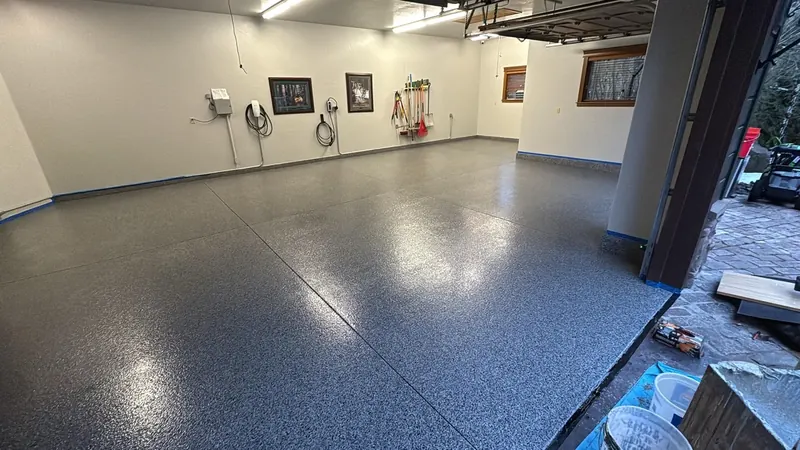
It usually happens on a warm day. You back the car out of the garage, and part of the floor coating leaves with it. What is left is bare gray concrete in the shape of a tire tread, with pieces of coating stuck to the rubber or scattered across the floor. The trade calls this hot-tire pickup. Anyone who has seen it once tends to remember it, which is a large part of why some people still distrust coated garage floors.
Rhino Coatings installs a polyurea base coat with a polyaspartic top coat over diamond-ground concrete. We do not install epoxy. This guide explains what is happening when a coating lets go under a tire, how to tell whether a floor is at risk, what prevents it, and what to ask before anyone coats your floor, us included.
What hot-tire pickup looks like
The damage shows up where the tires sit. On a floor that is starting to go, you may first notice a few small bare spots in the tire paths, or the edge of a chip curling up where the tread rests. On a floor that fails all at once, whole tire-shaped patches come up in a single morning. Sometimes the pieces that lift carry a thin skin of concrete on their undersides.
It tends to arrive with warm weather, often in the first warm season after the floor was coated. Summer pavement and highway miles make tires hotter, and a coating that came through the winter looking fine can let go the first time a really hot tire sits on it. Winter brings a different set of problems, which we covered in why epoxy garage floors fail in Northwest winters.
A milder version is tire marking, where tire-shaped stains appear in the coating under the parked car and nothing lifts. Marking and pickup share a cause, which the next section explains. On its own, marking is a cosmetic problem.
Why hot tires pull a coating up
What follows is the general explanation used in the coatings trade. Not every failure involves every piece of it.
Tires come home hot
A tire warms up as it rolls, flexes and grips the road, and hot summer pavement adds to it. A car that has just come off the highway on a July afternoon brings that heat into the garage and parks it in one spot.
Tire rubber carries plasticizers
Rubber for tires is made with plasticizers, compounds that keep it soft and grippy. Euclid Chemical, which makes concrete sealers and coatings, puts tire marking and hot-tire pickup down to plasticizer migration in a technical bulletin. As a tire heats up, the bulletin explains, the plasticizers soften and leach out of the rubber, and when the hot tire is driven or parked on a sealed floor they migrate into the sealer or coating (Euclid Chemical, Tire Marking / Pickup of Concrete Sealers). The same bulletin points out that higher-quality tires carry more plasticizer than lower-quality, harder ones, so they are more likely to mark.
How much that matters depends on the coating. According to the bulletin, most of the discoloration happens on acrylic cure-and-seal products, because acrylics are only lightly crosslinked. Epoxy and urethane coatings are much more crosslinked and less likely to mark, though it can still happen. The more crosslinked a coating is, the denser it is and the better it resists that discoloration.
Tires are not the only rubber on a garage floor. The bulletin also lists rubber mats, rubber-backed rugs and the weatherstripping along the bottom of a garage door among the things that can stick to or stain concrete sealed with a cure-and-seal product.
Heat softens weaker coatings
Heat softens coatings to different degrees. A thin film, a coating that has not finished curing, or a one-part floor paint gives way far more easily under a hot tire than a thick, fully cured, hard top coat does. The usual explanation in the trade is that heat and plasticizer together leave a weak coating soft and tacky right where the tire rests, so the coating bonds to the rubber.
The weakest bond lets go
When the car pulls away, the tire pulls on the coating. Wherever the coating is holding onto the tire harder than it is holding onto the concrete, it comes up. Put simply, hot-tire pickup happens when a thin coating softens under a warm tire and lets go of poorly prepared concrete.
Poorly prepared covers a lot of ground. The top skin of a slab, called laitance, is weaker than the concrete below it, and a coating stuck to laitance is only as strong as that skin. Dirt, oil, an old sealer or a curing compound left on the surface keep the coating from reaching sound concrete at all. Moisture moving up through the slab can weaken the bond from below. A lifted piece with concrete on its back usually means the top of the slab was the weak link. A lifted piece with a clean, smooth back usually means the coating never bonded well in the first place.
An uncured coating is easier to lift
Any coating is at its softest before it has fully cured, which is why the wait before you drive on a new floor matters. On the floors we coat, you can walk on it in about 8 hours and drive on it in about 72, once the top coat has fully cured. Cold slabs can lengthen the cure, so on cold-weather jobs we confirm that timing before we start, or move the date.
Why it gave garage coatings a bad name
Hot-tire pickup is the failure that gave garage floor coatings their bad name, and it is easy to see why. It is sudden, it is ugly, and it happens right where you look every time you pull in. A floor that peels slowly along one wall can be ignored for a while. Bare tire prints in the middle of the floor cannot.
For many homeowners, the first coated garage floor they saw up close was floor paint or a weekend kit. Those go on thin, and kits usually rely on an acid etch rather than grinding to prepare the concrete. When floors like that let go under hot tires, the easy conclusion was that garage coatings do not work. The material got the blame, and the prep under it usually deserved more of it. When we are called out to a floor that is peeling or bubbling, the problem almost always traces back to prep that was not done with industrial diamond grinders.
The top surface still matters, as Euclid's point about crosslinking shows. A floor that holds up under hot tires needs both halves, a strong bond to the concrete and a hard, dense top coat. If you are weighing a kit for your own garage, we wrote about what DIY epoxy kits actually last.
How to tell whether a floor is at risk
None of these signs proves a floor will fail, and a floor can show one or two of them and still hold up. Several together are a good reason to look closer before summer.
- It is paint or a kit. Floor paint, one-part products and thin kits are the usual candidates. A receipt, an old can on a shelf or the previous owner can often tell you what went down.
- The slab was etched, or not prepared at all. Without grinding, the bond depends on how clean and sound the surface happened to be.
- The film is thin. If you can see and feel the texture of the concrete through the coating, there is not much coating there.
- It softens in the heat. A coating that feels tacky, or dents under a fingernail on a hot afternoon, is likely to be softer still under a hot tire.
- It is already lifting somewhere. Small bare spots in the tire paths, curling edges around chips, or peeling near the door all point to a weak bond.
- There are tire stains where the car sits. Staining alone is cosmetic, but it shows plasticizer from the tires is getting into the coating.
- It blisters. Blisters in a coating suggest moisture or trapped air working on the bond from below.
What prevents hot-tire pickup
Prevention follows from the explanation above. The bond to the concrete has to be stronger than the grip a hot tire gets, and the surface the tire touches has to stay hard and resist what the tire leaves behind. On the floors we coat, that is built in layers, and how each one goes down is on our garage floor coatings page.
Grinding the concrete
Diamond grinding takes the weak top layer off the slab, along with old coatings, sealers and surface contamination, and opens the pores so the base coat bonds into the concrete instead of sitting on top of it. An acid etch is the shortcut. It cleans and roughens the surface, but it cannot get through a sealer, a curing compound or an old coating, and the result depends on how evenly the acid reached the slab and how well it was rinsed off. We diamond-grind every slab we coat, and we do not acid-etch.
Repairing the slab first
A coating cannot hold onto concrete that is coming apart under it. Cracks and control joints get filled with polyurea, which stays flexible through freeze-thaw, and spalls and pitted areas are repaired before any coating goes down.
Building real film thickness
Thin films are the ones that fail this way most often. A floor built in layers, with a base coat, a full broadcast of flake or silica and a top coat, has far more body than a single rolled coat. On our floors, the polyurea base coat bonds into the ground concrete and holds the broadcast, and multiple coats build the system thickness.
A hard, chemical-resistant top coat
The layer the tire touches does the most work. It has to stay hard when it is warm and resist what a car brings in, from tire plasticizers to oil and road salt. Our polyaspartic top coat is chemical-resistant and resists hot-tire pickup, and because it is UV-stable it does not yellow in the sun at the door either.
Questions to ask any installer
Whoever coats your floor, these questions get to the parts of the job that decide whether hot tires will be a problem.
- Do you grind the slab or acid-etch it? Grinding is the answer you want to hear.
- What happens to the coating on my floor now? If it is paint, a kit or anything that is already failing, it should come off, because a new coating is only as strong as the layer under it. We grind any old coating down to bare concrete before we coat.
- How many coats go down, and what is the top coat? Ask what the top coat is chemically and how it handles hot tires. The product data sheets will tell you more than a brochure.
- How long before I can drive on it? The answer should be based on full cure, and a good installer will tell you when cold weather changes it.
- Does the written warranty name hot-tire pickup? If it does not, ask why. Our warranty names peeling, delamination, and hot-tire pickup, in writing, on residential and commercial floors alike.
If your floor already has hot-tire pickup
Patching the bare spots tends not to last, because the coating around a patch usually has the same weak bond and the same soft surface, and the next hot tire finds the edge. A lasting fix starts with getting the old coating off.
We do not coat over failed epoxy, we remove it. The same diamond grinding that prepares any slab takes the old coating down to bare concrete, cracks and spalls are repaired, and the new system goes down on sound concrete. A floor with an old coating takes more grinding than a bare one, and the rep checks what is on yours at the free estimate. If you know what product went down, tell us.
If all you have is tire marking, try cleaning first, and test any cleaner in a corner before you use it everywhere. Euclid's bulletin says a concrete degreaser should work, depending on how deep the discoloration goes, and that staining which has migrated deep into a sealer or coating may mean removing it.
Garage floors in the towns we serve
We coat garage floors from our Coeur d'Alene shop across North Idaho and the Spokane area, and from our Boise location across the Treasure Valley, with the same grinding, repair, polyurea base coat and polyaspartic top coat on every slab. For your town, see garage floor coatings in Spokane, Coeur d'Alene, Post Falls or Boise.
Residential and commercial floors carry the same lifetime warranty against peeling, delamination, and hot-tire pickup. If you are not sure whether your floor is at risk, book a free on-site measure. We look at the slab and whatever is on it, show you colors on your own concrete, and give you a fixed, written price.