Are coated concrete floors slippery? How grip is built in
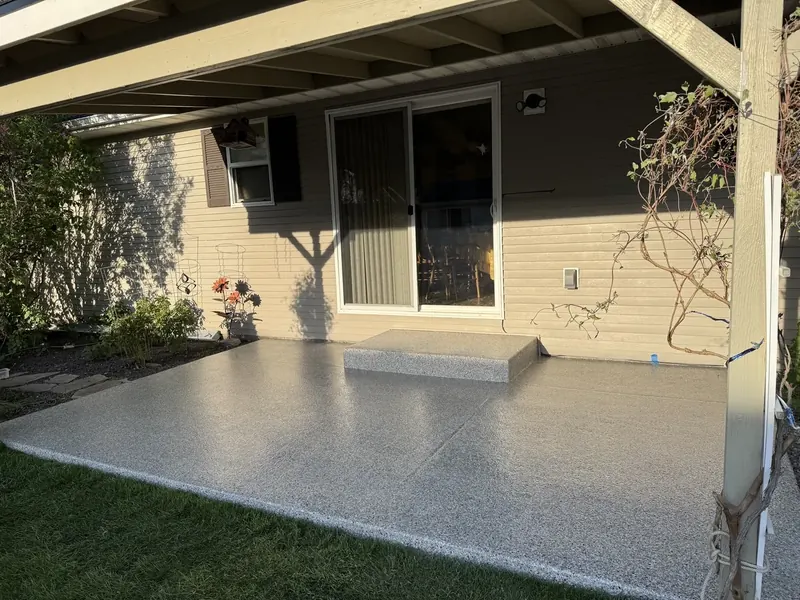
Most people who ask whether a coated floor is slippery are picturing a glossy garage floor, a puddle of snowmelt behind the car, and someone in smooth-soled shoes stepping into it. It is a fair worry. Some coated floors are slick when wet and some are not, and the difference is in how the surface is built.
Rhino Coatings installs a polyurea base coat, a hand broadcast of flake or silica, and a polyaspartic top coat. We do not install epoxy. This guide explains what makes a floor slippery, how grip is measured and built in, and how to keep it when the floor is wet.
Are coated garage floors slippery when wet?
They can be, if the surface is smooth and glossy. A floor built with a full broadcast of flake or silica has texture in it, which gives a wet shoe something to grip, and silica grips better than flake when wet. No floor is slip-proof, though. Water, oil, ice or a film of soap cuts the grip of any surface.
That holds whatever the resin is called. A smooth epoxy floor, a smooth polyaspartic floor and a glossy sealer all get slick when wet, so anyone shopping for an anti-slip or non-slip concrete coating is really shopping for texture. Every floor we coat gets a full broadcast, so the texture is part of the floor itself. Our garage floor coatings page shows how each layer goes down.
What makes a concrete floor slippery?
A smooth surface with something slick on top of it. On a clean, dry floor, the sole of a shoe touches the surface directly. Put a film of water, oil or soap between them, and on a smooth surface the sole rides on the film. Texture helps because its high points still reach the sole through a thin layer of water.
That is why interior concrete, which is usually troweled smooth, turns slick when it is wet, and why glossy sealers do too. In a garage, the usual culprits are these.
- Snowmelt dripping off the car and pooling inside the door and in the low spots.
- Ice, when that meltwater refreezes in a cold garage. No finish grips on ice.
- Oil and other fluids from a drip under the engine.
- Residue, such as soap left after a wash or the film road salt leaves when meltwater dries.
- Dust and grit, which make a smooth surface slicker underfoot.
Footwear matters too. Socks and smooth soles slip more easily than a treaded boot.
How is slip resistance measured?
With a friction test. For hard floors in the US, the usual figure is the dynamic coefficient of friction (DCOF), which describes how much friction resists one surface sliding across another that is already moving. A higher number means more grip. An automated drag-sled device, called a tribometer, pulls a standard test foot across the surface, wet or dry, and reads the friction.
The test method is ANSI A326.3, the American National Standard for measuring the DCOF of hard surface flooring in the laboratory and in the field. As one resinous flooring maker's guide to the standard summarizes it, a level interior floor that will be walked on when wet should test at a wet DCOF of 0.42 or higher, and a floor that tests lower belongs where it will be kept dry, unless the manufacturer declares otherwise. The guide also notes that standards written for tile and stone can be applied to resinous floors too.
An explainer on the ANSI Blog adds that the national specification for ceramic tile uses the same 0.42 line, and it cautions against reading a wet DCOF result as a sign of whether a slip can occur.
The 0.42 line covers level interior floors. Three of the standard's five product use categories are left for the flooring manufacturer to declare. They cover wet interior areas such as public showers, wet outdoor spaces such as patios, pool decks and walkways, and level areas regularly exposed to automotive fluids. A home garage comes closest to the automotive-fluids category, though it is dry most of the year, wet in winter and spotted with oil only now and then.
Coatings add one more consideration. A tile's surface is formed at the factory, but a coated floor is made on site, so its texture depends on how full the broadcast was and how the top coat went down. A floor is only as grippy as the work that built it.
What do the ADA and OSHA require for slip resistance?
The ADA Standards require accessible floors in the buildings they cover to be slip resistant, without setting a minimum number. OSHA's general rule for workplaces requires employers to keep walking surfaces clean and free of hazards such as spills, snow and ice, and workroom floors dry where feasible.
Accessible floor and ground surfaces must be "stable, firm, and slip resistant," and the US Access Board's guide to the ADA Standards explains that no minimum coefficient of friction comes with that rule, because no method for rating slip resistance has won general agreement and a rating only means something next to the test that produced it. Compliance comes down to choosing materials, textures or finishes that prevent or minimize slipperiness in the conditions the surface is likely to see.
You may still see 0.6 quoted as an ADA figure. It comes from the advisory appendix to the original 1991 ADA Standards, which recommended a static coefficient of friction of 0.6 for accessible routes and 0.8 for ramps, a different measurement from the dynamic figures above. The same appendix observed that some slip is a normal part of walking, and that a truly "non-slip" surface could not be walked on.
A private home used only as a residence is not covered by the ADA's Title III rules, according to the Justice Department's Title III regulations. OSHA's rule for walking-working surfaces also calls for drainage and, where feasible, dry standing places such as mats where work is wet. On shop floors where equipment brings in snow or the floor gets washed down, we recommend silica.
How does a flake or silica broadcast add grip?
It puts texture into the floor itself. While the polyurea base coat is still wet, flake or silica is thrown by hand across the whole floor until the surface will not hold any more, which is called broadcasting to full refusal. The base coat holds the broadcast in place, the clear polyaspartic top coat seals it, and the texture you feel underfoot starts with that broadcast.
A full broadcast matters because a light sprinkle of flake, scattered for looks, leaves much of the floor as smooth coating between the chips, and a wet shoe finds the smooth parts. A full broadcast covers the whole surface, so the texture is the same at the door as at the back wall.
The two finishes feel different. Flake is a textured broadcast with some grip, the usual choice for a dry garage, basement or shop. Silica sand gives a finer, denser texture that reads as smooth to the eye and grips better when wet, so we recommend it for floors that get wet often. Our guide to flake vs silica finishes covers the looks and how to choose.
What about anti-slip additives in the top coat?
They are a common way to add grip. A grit, such as aluminum oxide or a polymer grit, is stirred into the final coat so the surface cures with texture. The same resinous flooring maker's guide lists aluminum oxide and granulated polymer as texture additives, alongside broadcast finishes such as vinyl flake and quartz.
Additives work, and they come with practical limits.
- Evenness depends on the mixing. Grit settles in the bucket. The data sheet for one aluminum oxide additive sold for garage floor coatings says to mix it into the final coat only and to remix periodically so the settled grit stays evenly dispersed.
- It sits in a thin layer. The grit lives at the surface, where shoes and tires wear. The US Access Board notes that applications and finishes used to raise a surface's slip resistance may need continued maintenance or reapplication.
- More grit means more to clean. A rougher surface holds more dirt, and the coarser the grit, the rougher it feels underfoot.
Broadcasts and additives can be combined. Whoever you hire, ask where the grip on your floor comes from, whether the broadcast is full, and, if they quote a slip rating, which test produced it and whether it was wet or dry. Then feel a sample of the finish you are buying.
How do you keep a garage floor from getting slippery in winter?
Choose the finish for how wet the floor gets, then manage the water. Squeegee meltwater out the door after a storm, catch the drips with containment mats, and put a mat where people step from the garage into the house.
Snowmelt does not spread evenly. It drips off the wheel wells, pools inside the door and under each car, and runs to the low spots, and in an unheated garage it can refreeze. A few habits keep it under control.
- Squeegee early. A floor squeegee pushes meltwater out the door before it spreads, freezes or dries into a salty film.
- Use containment mats, and empty them. A mat that never moves keeps the floor under it wet, so lift it now and then and let the floor dry.
- Put a mat at the house door. The step into the house is where wet shoes meet a smooth step, so give them somewhere to dry on the garage side first.
- Rinse off the salt. Dried salt and sand leave a gritty film. Wash it off with water and a mild soap, then rinse again so no soap film is left.
- Wipe up drips. Oil is slick on any floor, and a drip that keeps coming back is a leak to fix on the car.
If your garage is wet all winter, or you wash it down often, we recommend silica.
What is the best non-slip finish for a patio, steps or pool deck?
Silica. Outdoors, we recommend silica for uncovered patios, walkways, porches and steps, and pool decks, because its fine, dense texture grips better when wet. Flake works well on a covered patio, sunroom or greenhouse floor that stays dry.
Porch steps and treads are where wet shoes land first, so we coat the porch slab and the step faces and treads together, and the finish runs to the door. A pool deck is wet all summer, with bare feet on it every day. A sealed, broadcast walkway gives firmer footing than smooth, bare concrete. More on outdoor floors is on our patio, porch and pool deck coatings page.
Steps deserve the most care if anyone in the house is unsteady on their feet. According to the CDC's facts on older adult falls, "more than one out of four older people falls each year," and broken or uneven steps are among the hazards at home. Grip on the treads helps, and so does a sound surface, which is why cracked, spalled or flaking concrete is repaired and ground flush before the base coat goes down. We do not pour, lift or level sunken concrete, so a settled step needs a concrete contractor first.
Does a textured floor take more cleaning?
A little more. The texture that grips a shoe also holds fine dirt, so a silica floor may need a soft-bristle brush and soapy water where a mop would glide over a smoother floor. Flake hides dust and tire marks between cleanings, but the grit is still there and still needs sweeping.
Cleaning is also part of keeping the grip. Dust, dried salt and old soap film sit on top of the texture and make any floor slicker. Our guide to cleaning a coated garage floor has the routine, season by season.
More texture is not automatically better, since a very coarse surface holds more dirt. The right amount is enough grip for the way each floor gets wet.
Can you see the finish before you choose?
Yes. At the free on-site measure, the rep lays flake and silica samples on your own slab, in your own light, so you can compare both before you decide. We bring samples to garages, patios and porches across North Idaho and the Spokane area from our Coeur d'Alene shop, and across the Treasure Valley from our Boise location, including Coeur d'Alene, Sandpoint, Eagle and Boise.
Residential and commercial floors carry the same lifetime warranty against peeling, delamination, and hot-tire pickup. Book a free on-site measure and the rep will measure the floor, check the concrete, show you both finishes on your own slab and give you a fixed, written price.