How to clean and maintain a coated garage floor
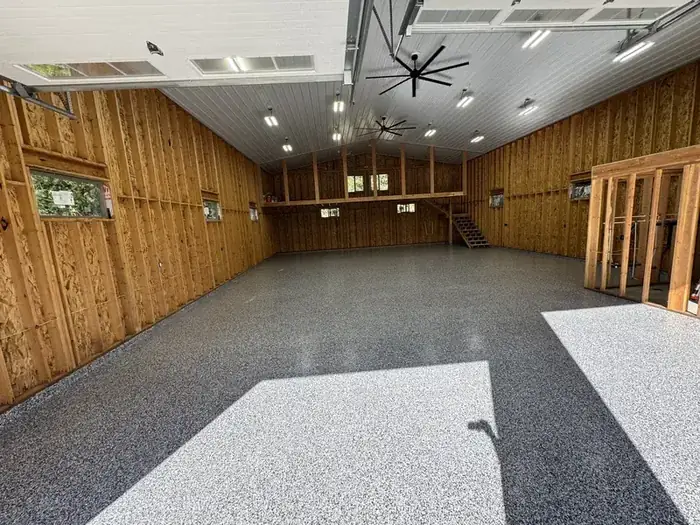
A coated garage floor is easy to keep clean, and for a lot of people that is a big part of the reason to coat one. Bare concrete soaks up oil, sheds dust and holds onto salt. A sealed floor keeps all of that on the surface, where a broom, a mop or a squeegee can reach it. Easy still takes a routine, though, and a simple one is what keeps the floor looking the way it should.
Rhino Coatings installs a polyurea base coat with a polyaspartic top coat over diamond-ground concrete. We do not install epoxy. The routine below is written for that kind of floor, a flake or silica broadcast under a polyaspartic top coat, and most of it is sensible for any coated garage floor. If your floor came with care instructions from whoever installed it, follow those first.
The first days after the install
A new floor needs a little patience before it needs any cleaning. You can walk on it in about 8 hours. You can drive and park on it in about 72 hours, once it has fully cured.
Until it has had that full cure, keep things simple. Keep the cars off it, do not roll or drag anything heavy across it, and do not leave anything wet or chemical sitting on it. If dust or leaves blow in before then, a soft broom is all it needs. Ask the crew before heavy things like a freezer or a loaded shelving unit go back on the floor.
Sweep or dust-mop often
The thing that wears any floor finish fastest is grit. Sand, road grit and dried salt get tracked in on tires and boots, and every footstep and every turn of a tire rubs them against the surface like fine sandpaper. On a glossy top coat, that shows up over time as dull patches and fine scratches in the traffic lanes.
So the most useful habit is also the simplest one. Sweep or dust-mop regularly. A wide microfiber dust mop picks up fine dust well on a sealed floor, and a soft-bristle push broom handles the coarser stuff. A leaf blower works too, for pushing dry dust and leaves out the door. How often depends on the garage. Once a week is a reasonable rhythm for most, and more often in winter, when the cars bring in sand and salt every day.
Washing: water, mild soap and a squeegee
When sweeping is not enough, wash the floor. Water and a mild soap are all a coated floor needs. Mix a little soap into a bucket of warm water, mop it on or work it in with a soft-bristle brush, and push the dirty water out the door with a floor squeegee. Then rinse with clean water and squeegee again, so the soap does not dry into a film that holds dirt.
A garden hose is fine for rinsing, and there is no need for a pressure washer. Make sure the water has a clear path to the door instead of pooling under shelving or against the walls. If your garage has cabinets, keep standing water off the cabinet bases.
How often to wash is up to you. For many garages, every month or so is plenty, with extra washes in winter and any time the floor still looks dull or gritty after a sweep.
Winter: salt, deicer and meltwater
Winter is the hardest season on any garage floor. Cars carry slush loaded with road salt, sand and deicer into the garage, and it melts off onto the floor. On a coated floor, road salt and deicer sit on top of the polyaspartic top coat until you rinse or squeegee them out the door, so the concrete underneath stays out of it.
The salt does not go away on its own, though. Left to dry, it turns into a gritty white crust, and that grit gets ground in underfoot. Our guide to road salt and deicer damage on garage floors covers what salt does to bare concrete. On a coated floor, the winter routine is short.
- Squeegee the meltwater out. After a storm, push standing water out the door before it dries into a crust.
- Rinse off the white film. Salt residue comes off with water and a mild soap. If the first rinse leaves a haze, rinse again.
- Knock the slush off outside. Clearing packed snow from the wheel wells before you pull in keeps a lot of salt water off the floor in the first place.
- Do a real clean in spring. Once the roads are dry, give the floor a thorough wash, so the season's salt and sand come off before they get ground in all summer.
Rubber mats: what they catch and what they trap
Containment mats, the kind with a raised lip, are useful in winter because they hold the meltwater that drips off the car instead of letting it spread across the floor. They need emptying, though, and a mat that never moves keeps the floor under it wet for the whole season.
Any mat traps things underneath it, whether it is a containment mat, a rubber mat at the door or a rubber-backed rug in front of the workbench. Grit works its way in under the edges. Water that gets under a mat cannot evaporate. And grit pinned under a mat gets pressed into the surface every time someone steps on it or a tire rolls over it.
Mats are still worth using where they help. Lift them now and then, sweep and rinse the floor underneath, and let it dry before you put them back. If a mat stays down all year, check under it as part of the spring clean.
Oil, fluids and other spills
Spills are where a coated floor earns its keep. Bare concrete is porous, so oil soaks straight in and stains it for good. A sealed polyaspartic surface resists motor oil, brake fluid and antifreeze, and spills wipe up with a rag instead of staining the concrete.
Resisting a spill is different from ignoring one, so wipe things up when you see them rather than leaving them for later. For a small drip, a rag and a little soapy water are enough. For a bigger spill, soak it up first with paper towels or an absorbent, sweep the absorbent up gently without grinding it into the floor, then wash the spot. A drip that keeps coming back in the same place is a leak to fix on the car.
Antifreeze deserves quick attention for another reason. The ASPCA advises cleaning up antifreeze spills thoroughly before letting pets back into the garage (ASPCA: What pet dangers are in your garage?).
Tire marks
Tires can leave dark marks where they sit or turn. Start with the gentlest thing that works: warm water, a mild soap and a soft-bristle brush, worked over the mark a few times. Give it several passes before reaching for anything stronger.
A mark that will not come up with a gentle cleaner is something to ask your installer about before you reach for a scouring pad or a harsh chemical, either of which can do more damage to the finish than the mark did.
This is one place where the finish you chose makes a difference day to day. A flake floor's speckled pattern hides dust and tire marks between cleanings, so a mark that would stand out on one even color is harder to see.
Silica and flake floors
Both finishes get the same care. The main difference is texture. Silica has a finer, denser texture, which is what gives it its grip when wet, and any textured surface holds onto fine dirt a little more than a smoother one. On a silica floor, a soft-bristle brush and soapy water may lift dirt that a mop glides over.
Flake floors hide dust and tire marks between cleanings, so they can look clean for longer. The grit is still there, though, and it still needs sweeping.
What to avoid
- Abrasive pads and scouring powders. Steel wool, wire brushes, scouring pads and gritty cleansers can scratch and dull a glossy top coat.
- Harsh cleaners. Strong solvents and harsh chemical cleaners are more than a coated floor needs, and not every product made for bare concrete is meant for a coated one. When in doubt, use water and a mild soap, or ask your installer.
- Dragging heavy or sharp things. The top coat is more abrasion-resistant than epoxy, but it is still a floor finish. Lift or roll heavy things instead of dragging them, and put a scrap of plywood under a jack stand or a motorcycle kickstand that will sit in one spot for a long time.
- Hot work. Sparks and hot slag from welding, cutting or grinding metal can mark any floor coating. A welding blanket on the floor under the work is simple protection.
- Wax and shine products. There is no need to wax a coated floor. The top coat is the finish.
A simple routine
- Weekly, or as needed. Sweep or dust-mop.
- Monthly, or when it looks dull. Wash with warm water and a mild soap, then rinse and squeegee.
- After every storm. Squeegee the meltwater out the door and empty the containment mats.
- Spring and fall. Lift the mats, wash the whole floor, and look over the threshold and the edges, where water, salt and sun hit hardest.
- Whenever it happens. Wipe up spills.
When something looks wrong
A coated floor that gets swept and washed does not need much else. If you notice something cleaning does not fix, such as a spot that looks lifted, a chip, or a stain that will not come out, call the company that installed the floor before you try a repair yourself. A patch with a hardware-store product can make a professional repair harder.
The first few feet inside the door take the most water, salt and sun, so that is the first place to look when you check the floor over. A problem caught early is easier to deal with than one found after a winter.
Garage floors in the towns we serve
We coat garage floors across North Idaho and the Spokane area from our Coeur d'Alene shop, and across the Treasure Valley from our Boise location, including Coeur d'Alene, Hayden, Spokane Valley and Nampa. Our garage floor coatings page shows how each layer goes down, and why epoxy garage floors fail in Northwest winters explains what a floor here has to survive.
Residential and commercial floors carry the same lifetime warranty against peeling, delamination, and hot-tire pickup. If your garage floor is still bare concrete, a free on-site measure is the place to start: we look at the slab, show you flake and silica samples on your own concrete and give you a fixed, written price.