Resurfacing a worn garage floor: repair, overlay, coat or replace?
A garage floor that has gone rough, flaky or dusty sends a lot of people looking for resurfacing. The word gets used for very different jobs, from patching and coating the slab you have to spreading a thin layer of new cement over it, and some floors need a new slab instead. Which one fits depends on what is wrong with the concrete and whether the slab underneath is still sound.
Rhino Coatings repairs concrete and installs a polyurea base coat with a polyaspartic top coat over diamond-ground slabs. We do not install epoxy. This guide explains what each kind of wear means, what each fix can and cannot do, and how to tell when a slab is past repair.
What does resurfacing a garage floor mean?
It usually means one of three jobs: repairing and coating the slab, covering it with a thin cement-based overlay, or grinding it down to fresh concrete. When a slab is past all three, the fourth option is replacing it. Refinishing, renovation and restoration get used loosely for the same work, so ask which one a quote includes.
- Repair and coat. Cracks, spalls and pitted areas are repaired, the whole slab is diamond-ground, and a coating becomes the new wear surface.
- Overlay or resurfacer. A thin layer of cement-based mortar, often polymer-modified, is bonded over the old surface. The American Concrete Institute's terminology defines an overlay as a layer of concrete or mortar placed on a slab to restore or improve the function of the surface it covers.
- Grinding. Diamond grinding takes the weak or worn top layer down to sound concrete. On its own it leaves bare, porous concrete, so it is usually the first step of a repair or a coating, and one of several ways to prepare a slab for an overlay.
- Replacement. The old slab is broken out and a new one is poured, for a slab that has failed structurally or moved too far to repair.
Why is my garage floor flaking, pitting or dusting?
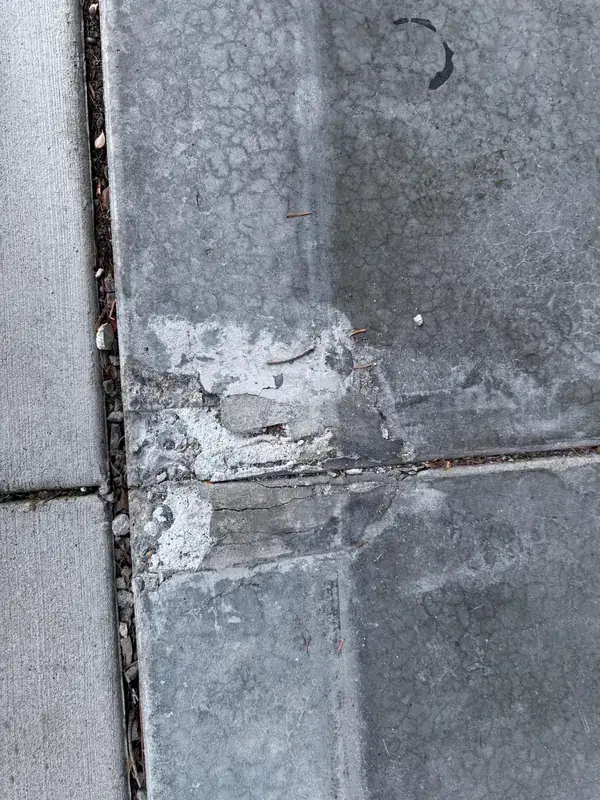
Flaking is usually scaling or spalling, small craters are pop-outs or pitting, and powder that never sweeps clean is dusting. Most of these start in the top layer of the slab and can be repaired. Cracks depend on whether the slab is still moving.
Scaling
Scaling is flaking or peeling of the finished surface caused by repeated freezing and thawing, starting as small patches that can merge and spread. Light scaling leaves the stone covered, moderate scaling exposes it and can cost up to 1/8 to 3/8 inch of surface mortar, and in severe scaling the stone stands out clearly. Deicing chemicals make it worse by keeping the surface wetter and adding freeze-thaw cycles, according to the National Ready Mixed Concrete Association's sheet on scaling concrete surfaces. Our guide to road salt and deicer damage covers how that plays out in a garage.
Spalling
The American Concrete Institute defines a spall as a fragment, usually flake-shaped, that breaks away from the concrete because of a blow, the weather, pressure or expansion inside the slab. On a garage floor, spalls leave shallow, rough craters. On the floors we repair, they come from freeze-thaw cycles, deicing salts or weak surface concrete.
Pop-outs
A pop-out is a small, roughly cone-shaped hole left when a piece of stone near the surface fractures from pressure inside it, often with part of the stone still at the bottom. In freezing climates the typical cause is a porous stone that soaks up water, which then freezes and expands; some pop-outs come from a chemical reaction in the stone instead. NRMCA's sheet on aggregate popouts calls most of them cosmetic, though a large number make it easier for water and chemicals to get into the concrete.
Pitting
Pitting is the development of small cavities in a surface, which in concrete means localized breakdown such as pop-outs, as the same ACI terminology puts it.
Dusting
Dusting is a loose powder that keeps forming on the surface, soft enough to scratch with a nail or even a broom. NRMCA's sheet on dusting traces it to a weak wearing surface. Causes include finishing while bleed water (the water that rises out of fresh concrete) was still on the slab, too little curing, and a new surface that froze or took exhaust from unvented heaters. Severe cases can be ground down to durable concrete, followed if needed by a bonded topping.
Crazing
Crazing is a web of fine, shallow cracks, rarely more than 1/8 inch deep, caused by shrinkage of a paste-rich surface layer. It usually shows up within the first week after the pour, is more visible as the floor dries after getting wet, and does not affect the slab's structural integrity, according to NRMCA's sheet on crazing. Dirt packed into the cracks makes it more visible.
Cracks
Concrete contracts and expands as its moisture and temperature change, and it can crack when that movement is not allowed for. NRMCA's sheet on cracking lists missing or poorly placed joints, a badly prepared subgrade, too much water in the mix, poor finishing and poor curing among the usual causes, and says most random early cracks rarely affect a slab's structural integrity or service life. A crack that keeps widening is another matter, and our guide to coating cracked concrete covers how each kind is repaired.
Can a worn garage floor be repaired and coated instead of replaced?
Usually, yes. Most damaged concrete can be restored to a coatable condition without replacement, as long as the slab is structurally sound.
We restore worn concrete by grinding and repairing the slab itself. The whole slab is assessed first, and the cause of each kind of damage (freeze-thaw, settlement, impact or shrinkage) is identified so the repair fits it.
- Cracks and control joints are filled with polyurea that stays flexible through freeze-thaw. Wide or structural cracks are ground out, filled with structural polyurea or cementitious mortar, and watched for movement before coating.
- Spalls and pop-outs are profiled with a grinder or scarifier and patched with cementitious repair mortar feathered to the surrounding surface.
- Pitting, exposed stone and the weak surface layer come off with diamond grinding, down to fresh, sound concrete.
- Edges and thresholds are rebuilt to their original profile.
- Old paint, epoxy or sealer is ground off completely, down to bare concrete.
Then the whole slab is diamond-ground, which opens the pores so the base coat bonds into the concrete. The polyurea base coat rebuilds the wear surface, flake or silica is broadcast into it to full refusal, and a UV-stable polyaspartic top coat seals it, leaving the repairs under one continuous surface. Most garages are done in one day; you can walk on the floor in about 8 hours and drive on it in about 72.
How each repair is done is on our concrete repair page, and how each layer goes down is on our garage floor coatings page. Repair is also available on its own, without a coating, for a garage floor, driveway, basement slab or commercial floor.
How is spalling on a garage floor repaired?
The spalled area is profiled with a grinder or scarifier, filled with cementitious repair mortar feathered to match the surrounding surface, and allowed to cure before the floor is coated. A patch on bare concrete still faces the meltwater and salt that caused the spall. On a coated floor they sit on the non-porous surface instead of soaking into the slab.
What is a concrete resurfacer or overlay, and when does it make sense?
A resurfacer is a thin layer of cement-based mortar bonded over an existing slab to give it a new concrete surface. It makes sense on a structurally sound slab with surface wear, when you want the floor to look like fresh concrete again. NRMCA suggests thin bonded resurfacing for light to moderate scaling, and a thin bonded overlay where pop-outs are too numerous to patch one at a time. It cannot fix a slab that is still cracking, sinking or heaving.
One widely sold bagged resurfacer is a blend of portland cement, sand, polymer and other additives, applied from a feather edge of 1/16 inch up to 1/2 inch thick. A concrete dressing intended for professional contractors goes on at 1/16 to 1/8 inch, up to 1/2 inch in small, well-defined areas.
NRMCA and the two data sheets set out what to plan for with an overlay.
- A sound, bare slab. NRMCA's scaling sheet says a repaired surface is only as strong as the base it is bonded to. The bagged resurfacer goes on bare concrete only, never paint or sealer, and the dressing's maker lists paints, sealers and curing compounds among the contaminants to remove. Badly damaged areas are repaired first, and existing control joints are kept.
- Room for movement. The dressing's maker calls it non-structural, too thin to restrain movement in the slab below, and the bagged product's sheet says reflective cracking cannot be completely prevented, especially where a slab lacks enough control joints or settles.
- Color. NRMCA notes that repair material will not match the color of the original concrete, and the dressing's maker says its product is not intended to match. The bagged product is designed to match typical concrete, but its sheet warns that concrete colors vary.
- Time to cure. The bagged product's sheet calls for 8 hours before foot traffic and 24 hours before vehicle traffic, with moist curing for 24 to 48 hours before use. The dressing can be walked on once it is hard and is meant to be sealed with a breathable, waterborne sealer as soon as it can be worked on, with full traffic and vehicles kept off until the sealer has dried thoroughly. Each product's own sheet sets its timing.
A resurfaced floor is still a cement surface. The dressing's maker says that, as with any concrete, it should be sealed to prevent dusting and to help resist damage from standing water, salt, oil and staining. If a coating is going down anyway, the coating becomes the wear surface, and an overlay under it is one more layer that has to stay bonded. A coating is only as good as the concrete under it.
When does a garage slab need to be replaced?
When the slab itself is failing. That is a slab that has heaved or sunk badly, keeps cracking because the ground under it is still moving, or is breaking down faster than it can be repaired. An overlay or a coating rides on top of the slab, so neither can hold a moving slab still.
The deciding question is structural integrity. If a slab has heaved significantly, is actively sinking or has deep structural failure, replacement may be warranted, and we tell you that honestly at the assessment. Surface damage can reach that point too. NRMCA's scaling sheet notes that repairing slabs with excessive, progressing scaling may not be feasible. The warning signs of a slab that is still moving are in our guide to coating cracked concrete.
A slab that has sunk can sometimes be raised instead. Raising a slab by pumping grout or foam under it is called slabjacking. The American Concrete Institute's field guide to slabjacking notes that it levels the slab without correcting poor soil beneath it and may need repeating if settlement continues. It also says replacement should be weighed against it, based on how cracked the slab is and how much more it is expected to move.
We do not pour, lift or level sunken concrete. If your slab needs lifting, a new section or a new pour, have that done first, and we will grind, repair and coat it after. New slabs are checked at the free estimate so we know they have cured enough to coat.
Can you coat over an old garage floor coating that is failing?
No. We do not coat over an old coating. Old epoxy, paint or sealer is diamond-ground off down to bare concrete, so the new system bonds to the slab itself.
A peeling coating is already letting go of the concrete, and anything bonded to it can only hold as well as it does. When we are called out to a floor that is peeling or bubbling, the problem almost always traces back to prep that was not done with mechanical diamond grinding. Removal is part of the standard prep, and a floor with an old coating simply takes more grinding. Once it is gone, cracks, spalls and pitting are repaired the same way as on any other worn floor.
Where does Rhino Coatings repair and coat garage floors?
We repair and coat concrete from our Coeur d'Alene shop across North Idaho and the Spokane area, and from our Boise location across the Treasure Valley. For the details where you live, see Sandpoint, Hayden, Liberty Lake and Spokane Valley.
Residential and commercial floors carry the same lifetime warranty against peeling, delamination, and hot-tire pickup. Book a free on-site measure and we will check the slab, tell you whether it needs repair, a coating or a concrete contractor first, and give you a fixed, written price.