Can you coat cracked or damaged concrete?
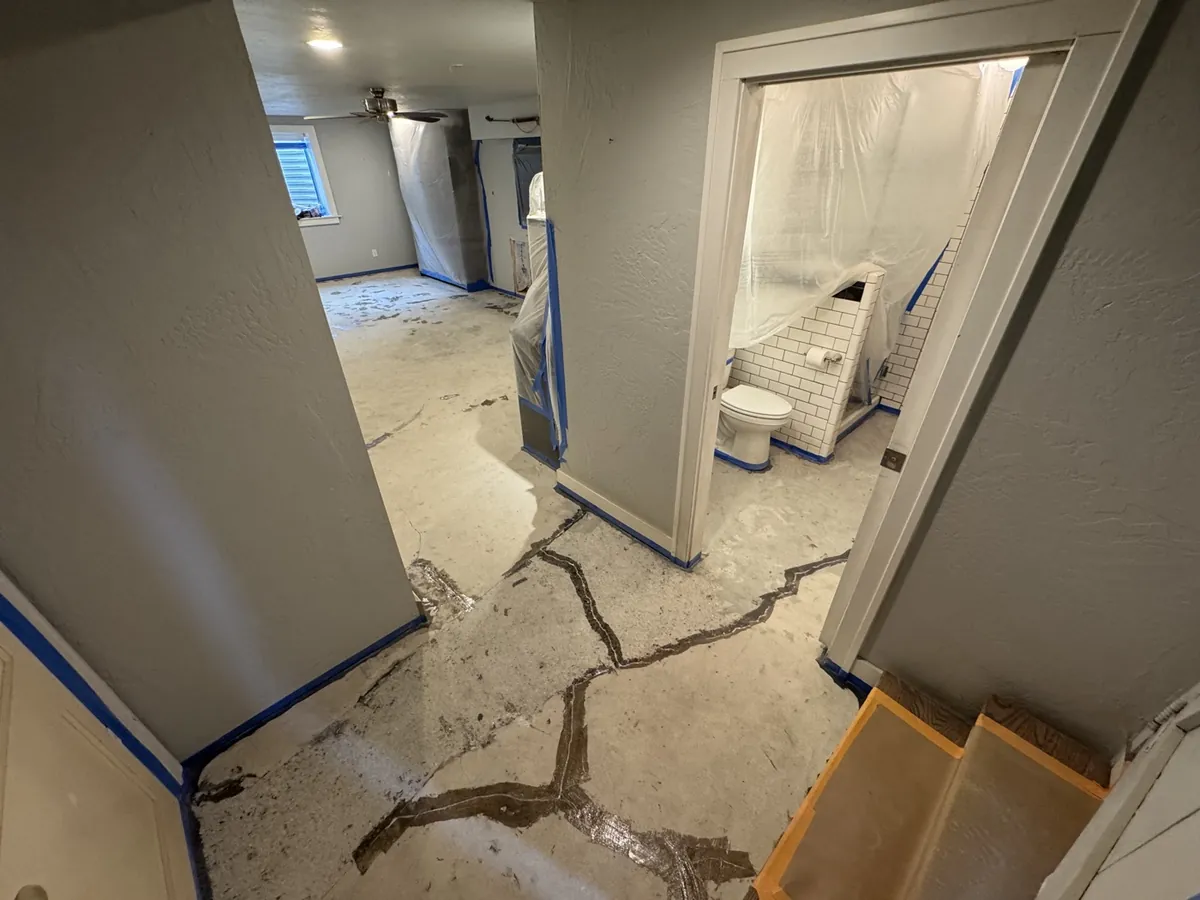
Almost every garage floor has cracks. Plenty also have chipped edges at the door, a rough patch where the surface has flaked away, or a crack that runs from one corner toward the other. If you are thinking about a coating, the natural worry is whether that damage rules it out, or whether a coating would only cover it up for a season.
Rhino Coatings installs a polyurea base coat with a polyaspartic top coat. We do not install epoxy. We also repair concrete, on its own or as the first step of a coating project, so this guide covers the kinds of damage a slab can have, how each one is repaired before a coating goes down, and the cases that belong to a concrete contractor first.
The short answer
Usually, yes. Most damaged concrete can be brought back to a coatable condition without replacing it, and on a coating job the repair is part of the prep. What matters more than how rough the floor looks is what caused the damage and whether it is still happening. A slab covered in fine hairline cracks can be a simpler floor to coat than one with a single crack that keeps opening.
Kinds of damage and what each one means
Hairline shrinkage cracks
Concrete shrinks a little as it dries, and a slab relieves that stress by cracking. Thin, wandering cracks that appear in a slab's first months or years are usually shrinkage cracks. They are common, they rarely signal a structural problem, and they are a routine repair on a coating job. We fill them with a semi-rigid polyurea that moves with the slab.
Control joints
The straight grooves cut or tooled across a slab are control joints. Concrete is going to crack as it shrinks, so the joints give it a weak line to crack along, out of sight at the bottom of the groove. A crack running down the length of a joint means the joint did its job. Joints also collect dirt and water and chip along their edges, and on a coated floor they are filled with polyurea before the base coat goes down.
Settlement and wide cracks
A crack that is wide, that has one side higher than the other, or that keeps growing is a different case. These usually come from movement, such as soil settling under the slab, a base that was never compacted well, water washing fill out from underneath, or frost pushing up from below. We treat cracks wider than 1/8 inch, and any crack caused by settlement or movement, as wide-gap or structural cracks. They are ground out and filled with structural polyurea or a cementitious mortar, and they are monitored for activity before the coating goes down.
Spalls
A spall is a spot where the surface has broken away and left a shallow, rough crater. Freeze-thaw cycles, deicing salts and weak surface concrete are the usual causes, and in a garage, spalls cluster where meltwater sits, in the first few feet inside the door. Our guide to road salt and deicer damage explains how that happens over a winter. Spalled areas are profiled with a grinder or scarifier, patched with a cementitious repair mortar feathered out to the surrounding surface, and allowed to cure before the floor is coated.
Pop-outs
A pop-out is a small, cone-shaped hole, often with a piece of broken stone at the bottom. It usually happens when a porous piece of aggregate near the surface soaks up water, freezes, swells and breaks out the concrete above it. According to the National Ready Mixed Concrete Association, most pop-outs are cosmetic and do not affect how the slab performs structurally, though a large number of them make it easier for water to get into the concrete (NRMCA, Aggregate Popouts). They are repaired the same way as spalls, so the base coat goes down over a solid, even surface.
Pitting and worn surfaces
Pitting is a scatter of small holes. A worn surface is one where the top layer of cement paste has eroded and the stones are starting to show. Both come from years of water, salt and traffic, or from a weak top layer left when the slab was finished. Diamond grinding takes off the worn surface and that weak layer, called laitance, down to sound concrete, and the pitting is filled before any coating goes down.
Edges and thresholds
The garage door threshold and the perimeter of a slab take more abuse than anywhere else, from standing water and salt to tires rolling over the lip and the blade of a snow shovel. Broken or crumbling edges are rebuilt to their original profile before the coating is applied, so the finished floor runs cleanly to the door.
An old coating that is failing
Peeling paint, epoxy or sealer counts as damage too, because a new coating is only as strong as the layer under it. We do not coat over failed epoxy, we remove it. Old coatings are ground off completely, down to bare concrete, as part of the prep.
What a coating project repairs
Repair happens in a set order. First the whole slab is assessed. Cracks are mapped, spalls measured and edges checked, and the cause of each is identified, whether that is settlement, freeze-thaw, impact or shrinkage. Then each kind of damage gets the repair that fits it.
- Cracks are ground out, injected and filled, with polyurea in most cracks and structural polyurea or a cementitious mortar in wide or structural ones.
- Control joints are filled with polyurea.
- Spalls and pop-outs are profiled and patched with repair mortar.
- Pitting and worn concrete come off with diamond grinding, and the remaining pits are filled.
- Edges and thresholds are rebuilt to their original profile.
- Old paint, epoxy and sealer are ground off to bare concrete.
- The whole slab is diamond-ground to the right surface profile for the coating, which removes the weak top layer and opens the pores so the base coat bonds into the concrete.
Coating straight over open cracks is how floors fail, so we never skip the repair. A slab with more damage takes more repair, and you get a fixed, written price for it, on its own or with a coating, with no surprise charges on install day. How each repair is done is laid out on our concrete repair page.
Repair is also available without a coating. If you only want the cracks and spalls fixed, on a garage floor, a driveway, a basement slab or a commercial floor, that can be done as a standalone job.
Why the repair has to flex
Concrete moves. It expands in warm weather and contracts in the cold, and the slab just inside a garage door can cross the freezing line over and over through a winter. Cracks open and close a little with those swings. A rigid filler in a crack that still moves tends to crack again along its edges or work loose, and once it does, the crack shows through whatever is on top of it.
That is why cracks and joints are filled with polyurea that stays flexible through freeze-thaw, and why the base coat above them is polyurea too. The repair and the floor over it move with the slab instead of fighting it. That matters most in a climate like ours, where the same movement repeats all winter, every winter.
What a coating can and cannot do
A coating does not stop concrete from being concrete. On a stable slab, flexible repairs under a flexible base coat ride out the small seasonal movement every slab has. On a slab that keeps settling or heaving, new cracks can open underneath any coating, and they will show through it. That is why the cause of the damage matters more than the amount of it.
On a finished floor, filled cracks and patches sit under the base coat and the broadcast of flake or silica, and the broadcast hides a lot of old scars. If your slab is new, the cracks you can see are most likely shrinkage cracks, and our guide on coating a new concrete garage floor covers what to expect in a slab's first months.
When the slab itself is the problem
Some damage is a sign the slab is still moving, and a moving slab is a concrete contractor's problem before it is a coating installer's. These are the signs to watch for.
- A crack that keeps getting wider, or comes back after it has been patched.
- One side of a crack sitting noticeably higher than the other, with the step getting worse.
- A slab that has heaved up, sunk, or tipped so water runs toward the house.
- A gap opening under the garage door where the threshold has dropped.
- A section that rocks underfoot, or soil washing out from under an edge.
Lifting or leveling a slab, replacing a section, and fixing the drainage that washed out the base are jobs for a concrete contractor, and they come first. We do not pour, lift or level sunken concrete, but once that work is done we can grind, repair and coat the slab. A coating bonds to the slab and goes wherever the slab goes, so it cannot hold a moving slab still. Once the concrete is stable, the grinding, repair and coating can follow.
Most damaged concrete can still be restored to a coatable condition without replacement. The deciding question is structural integrity. A slab that has heaved significantly, is actively sinking or has deep structural failure may need to be replaced, and we tell you that honestly at the assessment. Any good installer should do the same, and tell you at the estimate, before a date is set, instead of coating over a slab that is still on the move.
Questions to ask at the estimate
- Will you look at the whole slab before you price it? Cracks, spalls and edges need to be seen in person. A price from photos is a guess.
- What goes into the cracks and joints, and does it stay flexible? In freeze-thaw country, the answer matters.
- How will you repair the spalls and the threshold? Ask what material goes in and how it is finished flush with the floor around it.
- Is any of this still moving? If the answer is maybe, ask what they would do about it before coating.
- Do you grind or acid-etch? Grinding takes the surface down to sound concrete, which is where any repair and coating need to start.
- Is the repair in the written price? It should be, so nothing comes as a surprise once the work starts.
Concrete repair in the towns we serve
We repair and coat concrete from our Coeur d'Alene shop across North Idaho and the Spokane area, and from our Boise location across the Treasure Valley. For the details where you live, see Spokane, Spokane Valley, Sandpoint and Meridian.
Residential and commercial floors carry the same lifetime warranty against peeling, delamination, and hot-tire pickup. Book a free on-site measure and we will look at the cracks, spalls and edges with you, tell you what the slab needs, and give you a fixed written price, for the repair on its own or with a coating.