Flake vs silica: choosing a garage floor finish
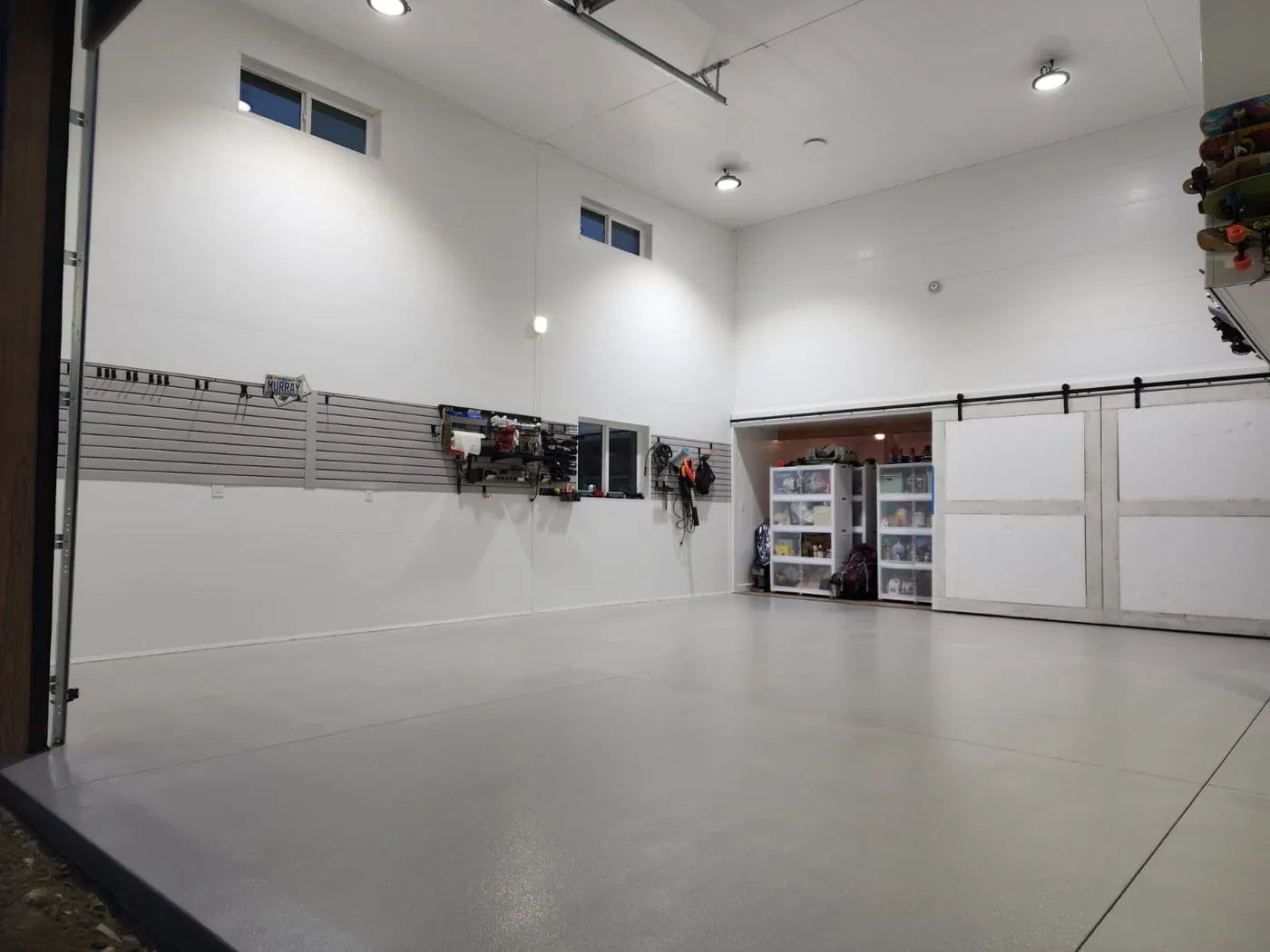
Once you have decided to coat a garage floor, the next decision is what it will look like. Every floor we coat gets one of two finishes, flake or silica. The choice changes the look, the feel underfoot and how well the floor grips when it is wet. It does not change what is underneath.
Rhino Coatings installs a polyurea base coat with a polyaspartic top coat. We do not install epoxy. Both finishes are broadcast by hand into the polyurea base coat to full refusal, which means until the surface will not hold any more, and both are sealed under the same polyaspartic top coat. So the choice is mostly about how you want the floor to look and feel, and where it gets wet. This guide walks through both, then through the practical ways to decide.
What each finish is
Flake
A flake floor has decorative vinyl flake broadcast by hand into the polyurea base coat, then sealed under a clear, UV-stable polyaspartic top coat. The flakes come in blends of several colors, so the finished floor is speckled, with depth to it. There are 13 blends.
Silica
A silica floor has silica sand broadcast into the same polyurea base coat, also to full refusal, under the same polyaspartic top coat. Silica floors are paint-matched, in more than 1,700 Sherwin-Williams colors, so the finished floor reads as one even color with a fine texture. If Sherwin-Williams makes the color, we can coat your floor with it.
Every floor we coat gets one or the other, as a full broadcast. Both are part of the same system, with the same prep under them and the same top coat over them.
How they look
Flake: pattern and depth
Flake is the busier finish. From standing height the floor reads as a mix of colors, and up close you can see the individual flakes layered over one another. The blends run from high contrast to quiet:
- Domino is black, white and gray, the high-contrast showroom-garage classic.
- Gravel is light gray, dark gray and white, and it hides dust and tire marks well.
- Coyote is slate gray, charcoal, white and silver, for a clean industrial look.
- Hickory (beige, brown, red and black) and Outback (beige, brown, tan and black) are the warm blends.
- Orbit (blue, gray, black and white) and Tidal Wave (blue-gray, light gray, white and deep gray) bring in blue.
The rest of the 13 are Cabin Fever, Creek Bed, Nightfall, Wombat, Shoreline and Basalt, which mix tans, beiges, cream, browns and grays with black and white.
Silica: one even color
Silica is the calmer finish to look at. The floor is a single, paint-matched color, which gives it a smooth, finished look. That suits a space meant to look finished: a showroom or an office, a finished basement, a mudroom or laundry room, or a garage where you want a more refined look. Because the color is paint-matched, a silica floor can also pick up a color from elsewhere in the house, such as the trim or the siding.
The trade-off is camouflage. One even color does not hide dust and tire marks the way a speckled blend does, so a silica floor shows when it is due for a sweep.
How they feel underfoot
Both finishes have some grip, because both are full broadcasts under a slip-resistant polyaspartic top coat. The difference shows up when the floor is wet.
- Flake is a textured broadcast with some grip. It is the usual choice for a dry garage, basement or shop.
- Silica has a finer, denser texture that grips better when wet. We recommend it for patios, walkways, porches and steps, pool decks and floors that get wet often.
Silica's texture is fine and dense, so to the eye the floor reads as smooth and even. Underfoot, that texture is what grips when the surface is wet. If you can, run a hand or a shoe across both samples at the estimate. It tells you more than any description.
Start with how wet the floor gets
Because silica grips better when wet, how wet the floor gets is a good first question.
- A dry garage, basement or shop. Flake is the usual choice, and the look can decide it.
- A garage that is wet often. If snowmelt comes off the cars all winter or you wash the floor down regularly, silica's grip is worth weighing. It is the same reason we recommend silica in shops where equipment brings in snow or the floor gets washed down.
- Outside. We recommend silica for an uncovered patio that takes rain, for walkways, and for porch steps, where wet shoes land first. On a pool deck, where bare feet are on it all summer, silica again.
- Covered and dry outdoor floors. Flake works well under a covered patio that stays dry, and on a sunroom or greenhouse floor that stays dry.
More on outdoor surfaces, and the finish we recommend for each one, is on our patio, porch and pool deck coatings page.
Choosing by light
Color looks different in every garage. A blend that reads warm under the overhead lights at night can look quite different with the door open in the afternoon, and the floor will spend time in both. In a dim garage or basement, light flake blends and pale silica colors bounce back the light you already have.
That is why the rep brings samples to your garage and lays them on your own concrete, in your own light, at the free estimate.
- Look at more than one time of day. If you can, look at the samples once with the door open and once under the lights you use at night.
- Look from standing height. You will mostly see the finished floor from standing height, so look at the samples down on the floor as well as in your hand.
- Use screens to narrow the list. Colors on a phone or monitor are approximate. Browse finished floors in our project photos, or try finishes on a photo of your own floor with the floor visualizer, then let the physical samples make the final call.
Choosing by use
Think about what the floor will spend its days doing.
- Hiding dust and tire marks. Flake is the better fit. A speckled blend hides dust, sawdust and tire marks between cleanings, and Gravel in particular hides dust and tire marks well.
- A working shop. Flake is the usual pick for a dry shop, for the same reason. If equipment brings in snow or the floor gets washed down, silica's grip matters more. Our shop floor coatings page covers working floors in more detail.
- A finished room. Silica's even, paint-matched color suits a finished basement, a mudroom or a laundry room, or a garage that doubles as a showroom.
- A floor that gets wet. Silica, for its grip.
Matching cabinets, walls and trim
If garage cabinets are part of the plan, choose the floor and the cabinets together. Our cabinets come in 18 melamine colors: Arctic White, Bone, Sand, Brushed Aluminum, Storm Gray, Slate, Hammered Gunmetal, Charcoal, Midnight Black, Steel Blue, Sage, Forest, Espresso, Patina Bronze, Copper, Hunter Orange, Brick and Cabernet. The floor goes down first, so the cabinets stand on a finished floor.
A few ways to make the two work together:
- Pull a color from the floor. A flake blend has several colors in it, and a cabinet color that echoes one of them ties the room together. Domino, for example, is black, white and gray, so there are obvious candidates among the whites, grays and blacks on the cabinet list. Color names are a starting point, though, so compare the real thing.
- Let one of them lead. If you want a bold cabinet color, like Hunter Orange or Cabernet, a quieter floor gives it room.
- Match the paint with silica. Because silica is paint-matched, a silica floor can pick up the wall color or the trim.
- Judge it in person. Cabinet swatches on a screen are approximate, and the final cabinet color is confirmed with you in person before your cabinets are ordered. Floor samples go on your own slab. If you can, see the two together before you decide.
The cabinet series, sizes and colors are on our garage cabinets page.
What stays the same either way
Whichever finish you choose, the rest of the floor is identical.
- The same diamond-ground prep, with cracks and joints filled with polyurea.
- The same polyurea base coat, broadcast to full refusal.
- The same UV-stable polyaspartic top coat, which does not yellow in sunlight.
- The same cure: walk on it in about 8 hours, drive on it in about 72.
- The same one-day install on most garages.
- The same lifetime warranty, residential and commercial, against peeling, delamination, and hot-tire pickup.
The finish you pick is one of the things that sets the fixed, written price, along with the size of the slab and the repair it needs, and the rep prices it at the free measure.
A short way to decide
- Decide how wet the floor gets. If it is wet often, start with silica.
- Decide how much you want the floor to hide. If you want dust and tire marks to disappear between cleanings, start with flake.
- Look at the light. In a dim space, lean toward lighter blends and paler colors.
- Think about what sits next to the floor: cabinets, wall paint, trim.
- Put the samples on your own concrete, and decide there.
For more on why the base coat and the top coat are two different materials, see polyurea vs polyaspartic. If you are choosing a finish for a new house, when you can coat a new concrete garage floor covers the timing. Every flake blend and the silica colors are on our polyaspartic floor coatings page.
Samples on your own floor
We bring flake and silica samples to garages across North Idaho and the Spokane area from our Coeur d'Alene shop, and across the Treasure Valley from our Boise location, including Sandpoint, Liberty Lake, Eagle and Boise.
Residential and commercial floors carry the same lifetime warranty against peeling, delamination, and hot-tire pickup. Book a free on-site measure and we will lay the samples on your own slab, in your own light, and give you a fixed, written price.