Melamine vs steel garage cabinets: an honest comparison
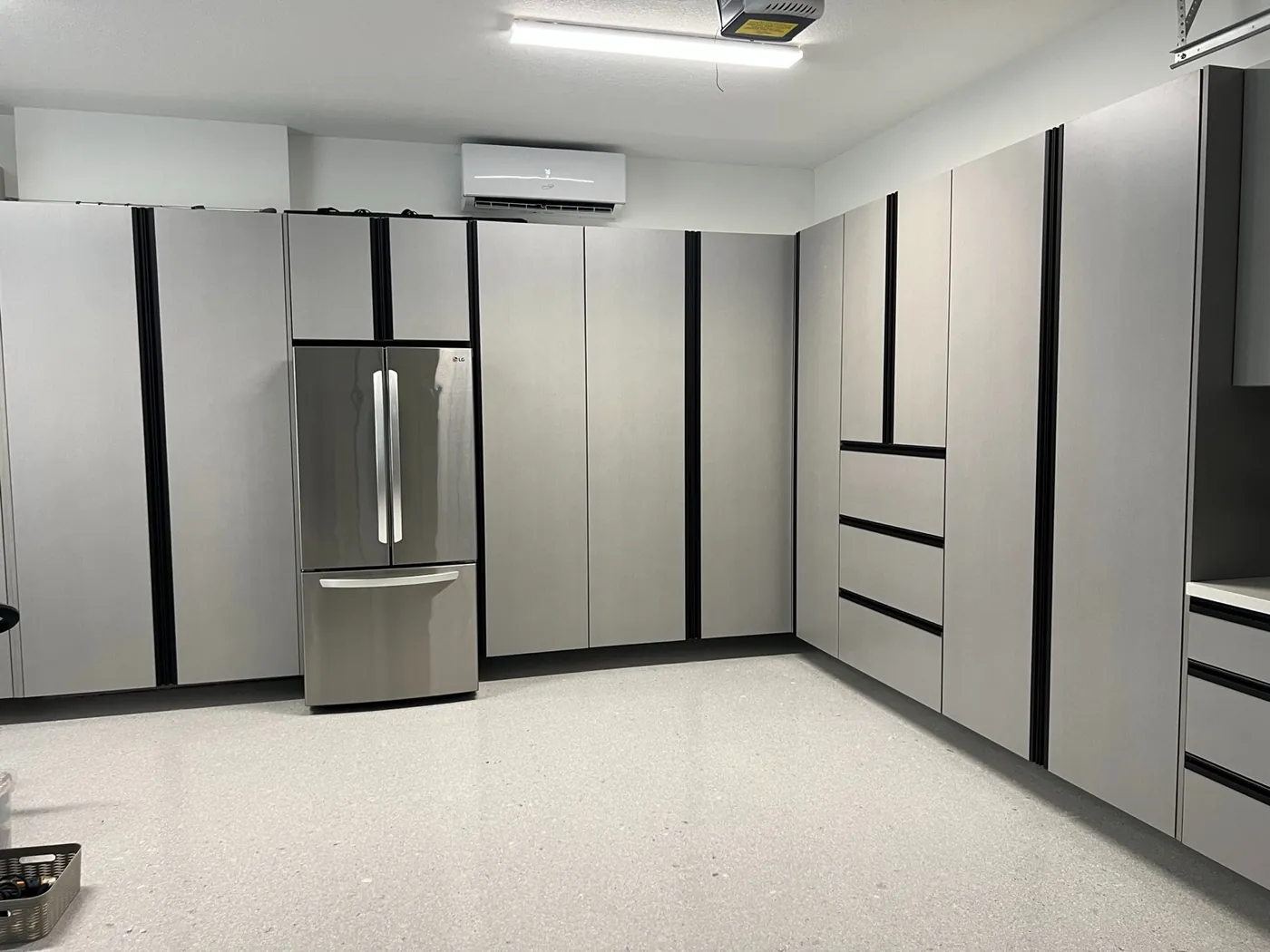
Two materials come up again and again when people shop for garage cabinets: melamine, which looks like finished cabinetry, and steel, which looks like it came out of a workshop. Both make good garage cabinets. They show wear in different ways, ask for different care and suit different garages, so the better choice depends on how you use yours.
We should say up front where we stand. Rhino Coatings installs melamine garage cabinets, made in the USA, in two series and 18 colors. We also coat garage floors, with a polyurea base coat and a polyaspartic top coat (we do not install epoxy). This comparison is written by a melamine installer, and we have tried to be fair to steel, because for some garages it is the better choice.
What each material is
Melamine is a surface. In cabinetry, the word means a hard, resin-saturated decorative layer fused onto a panel with heat and pressure. The color is part of that layer, so there is no paint to flake off. What the panel underneath is made of, and how thick it is, varies from one manufacturer to the next.
Steel garage cabinets are made from sheet steel, bent into shape and welded or fastened together. Most are finished with a powder coat, a baked-on finish that gives them their color and protects the metal. Steel thickness is given as a gauge, and a lower gauge number means thicker steel.
Neither word settles the question of quality on its own. Both materials are sold in budget lines and in heavy, well-built ones, and two cabinets that look alike in a photo can feel very different when you open the doors. Everything below compares the materials in general, so treat it as a starting point for questions about the specific cabinets you are being quoted.
Appearance and color
Melamine looks like cabinetry, with flat, even panels in one consistent color from door to door. It suits a garage you want to look finished, such as one the family passes through every day on the way into the house.
The 18 colors we install run from Arctic White, Bone and Sand through Storm Gray, Slate, Charcoal and Midnight Black to Steel Blue, Sage, Forest, Espresso, Copper, Hunter Orange, Brick and Cabernet, with Brushed Aluminum, Hammered Gunmetal and Patina Bronze among them. On-screen swatches are approximate, so the final color is confirmed with you in person before your cabinets are ordered.
Steel has a look of its own, crisp and industrial, and plenty of people want exactly that in a garage. Color choice depends on the brand. Many steel lines come in a handful of stock colors, and some makers offer a wider range of powder-coat colors. If matching a floor, a wall color or a truck matters to you, ask any steel supplier which colors they actually stock.
Dents versus chips
This is the difference you are most likely to notice day to day, and it cuts both ways.
Steel dents. A car door swung into it, a bike handlebar or a ladder that tips over can leave a dent, and the dent usually stays. Thinner steel dents more easily than thicker steel. Steel bends rather than breaking, though, so a dent is usually cosmetic, unless it scrapes through the powder coat and leaves bare metal showing, which matters for rust.
Melamine does not dent the way sheet steel does, and because its color is part of the surface, it has no paint to flake. Our cabinet page says sealed melamine resists scratches and the chemicals that come with garage life, and that it wipes clean. In general, the place a melamine cabinet shows damage is an edge or a corner, where a hard enough knock can chip it, and a chip on a corner is more noticeable than a scuff on a flat door.
Which trade-off suits you depends on what hits your cabinets. In a working shop where rolling toolboxes, floor jacks and steel parts knock into things constantly, a cabinet that dents instead of chipping can be the better fit. In a family garage, the usual culprit is a car door, and the best protection for either material is a layout that keeps the doors from reaching the cabinets at all. Our guide to garage cabinet sizes and parking clearance covers how to plan for that.
Moisture and humidity
Water is where the two materials differ most, and garages here see plenty of it, mostly as snowmelt and road spray dripping off the cars in winter.
Melamine handles a spill or a splash and wipes dry. In general, its weak point is water that sits. Standing water against the bottom edge of a cabinet, or against a chipped corner, can work past the surface into the panel underneath, and water damage inside a panel is hard to undo. Our cabinet page says to keep standing water off the cabinet bases, and to tell us at the design visit if you hose out the garage, so we can place the runs with that in mind.
Steel does not soak up water at all, which is a real advantage in a wet garage. Its weak point is rust. A steel cabinet resists rust only as well as its finish does, so wherever a scratch, chip or dent breaks through the powder coat to bare metal, a damp garage can start rust there. The bottom edges and feet that sit in meltwater are the places to watch.
For either material, the floor under the cabinets makes a difference. Bare concrete soaks up water and dries slowly. On a coated floor, water sits on the surface, where a squeegee can push it out the door before it reaches the cabinet bases. When we do both, the floor goes down first, so the cabinets stand on a finished floor instead of a bare slab. How we prep and coat that floor is on our garage floor coatings page.
Weight and wall mounting
It is easy to assume steel is the heavy option. In practice neither material is reliably heavier, because a cabinet's weight depends on the gauge of the steel or the panel under the melamine, and on the size of the cabinet.
What matters more is what holds the cabinets up. Tall cabinets and wall-mounted cabinets of either material are only as secure as what they are fastened to, which in a typical framed garage means the studs behind the drywall. In our Tradesman series, the two overhead cabinets are wall-mounted, and on install day every cabinet is leveled, anchored and tuned.
Whatever you buy, ask what each shelf and each wall cabinet is meant to hold, and load them with that in mind. Heavy things belong low, close to the floor, where a full shelf asks the least of the cabinet and of you.
Noise
Steel tends to be louder. Doors close with a metallic clang, a drawer full of sockets rattles, and a cabinet side can boom when something bumps it. Melamine panels close with a duller, quieter sound. If the garage shares a wall with a bedroom, or you are out there early in the morning, you may notice the difference.
Repairs down the road
Small damage on steel is usually touched up. A scratch through the powder coat can be cleaned and covered with touch-up paint to keep rust out, and a badly damaged door can sometimes be replaced. Dents are hard to take out of a flat panel without leaving a mark, so small ones are often left alone.
Melamine is not something you sand and refinish. Small chips are usually filled with a color-matched touch-up product, and a badly damaged door or panel is usually replaced. With either material, ask whether replacement doors and panels will be available in your color later on.
Where steel has the edge
- Water cannot get into it. In a garage that floods, gets hosed out often or takes a lot of standing meltwater, that can outweigh everything else on this list.
- It holds a magnet. Most steel cabinets will take magnetic hooks, trays and lights on their sides and doors, which is handy in a working shop.
- It takes hard knocks without breaking. Heavy-gauge steel stands up to a lot of shop abuse, and when it does give, it dents instead of chipping.
- The look. If you want the garage to look like a workshop, steel looks the part.
Where melamine has the edge
- Color and a finished look. Our 18 colors let you match the cabinets to your floor flake, your wall paint or your favorite race livery, in the words of our cabinet page.
- No dents of the sheet-metal kind, and no metal panels to rust. Day-to-day bumps that leave a steel door dented are less of a worry, as long as the edges are protected from hard knocks.
- Quiet. Doors and drawers close without the clang.
- Easy to keep clean. It wipes clean, and it resists the scratches and chemicals that come with garage life.
Which one fits your garage
Steel is usually the better fit if the cabinets will take constant hard knocks from heavy parts and rolling equipment, if the floor often has standing water where the cabinets would go, or if you want magnetic storage and an industrial look.
Melamine is usually the better fit if the garage is mostly for parking and storage, if you want a particular color or a finished look, if you would rather the cabinets stay quiet, and if the floor stays reasonably dry or is coated so water can be pushed out. If you hose out the garage and still prefer melamine, tell us at the design visit so we can place the runs.
What we install
The two series we install are both melamine, made in the USA, with adjustable shelving and the same 18 colors. The Garage Vault is a wall of 84 inch two-door pantries for closed storage. The Tradesman pairs tall pantries with base cabinets, wall-mounted overhead cabinets and a slatwall run, and of our two series it is the usual pick for a working shop. Both install in a shop or the enclosed bay of a pole barn the same way they do in a garage. Both come in runs of 10, 12 or 14 feet, and both are installed by our own crews. The sizes and the contents of every run are on our garage cabinets page.
Questions to ask any installer, whatever the material
- What exactly is the cabinet made of? For melamine, what is the panel underneath, and how thick is it? For steel, what gauge is it, and is it welded or assembled?
- Where are the cabinets made?
- How are the tall and wall-mounted cabinets fastened, and what are the shelves meant to hold?
- Can I see the colors in person before anything is ordered?
- Is the price fixed and in writing, and what does it include?
- What warranty comes with the cabinets, who stands behind it, and is it in writing?
- Will replacement doors and panels be available later?
Ask us the same questions at the design visit. Our guide to what a garage cabinet quote depends on covers the rest of what belongs in a quote.
Cabinets in the towns we serve
Our Coeur d'Alene location installs garage cabinets across North Idaho and the Spokane area, including Coeur d'Alene, Post Falls and Spokane, and our Boise location covers the Treasure Valley, including Boise. Both locations install the same two series in the same 18 colors, with our own crews.
The easiest way to decide is to look at the colors in person and talk through how you use the garage. Book a free design visit. We measure the garage, walk you through both series and the colors, and give you a fixed, written price before anything is ordered.